[ About Us | Popular | Marcom | AdNet | IChannel | Glossary ]
Showing posts with label mobile. Show all posts

Apr 23, 2009

Android Catches Up To Palm In Mobile Ad Market Share. IPhone Still Blows It Away.

from TechCrunch by 

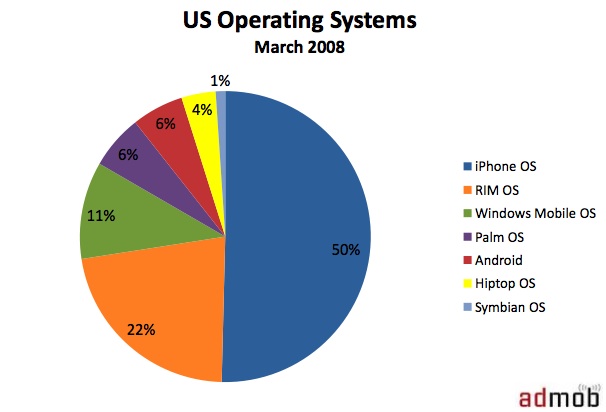
Android is making steady gains in mobile ad market share, accounting for 6 percent of all mobile ad requests measured by AdMob in its latest March metrics (full report embedded below). That puts it neck and neck with the Palm OS, compared to a 5 percent /7 percent share split in favor of Palm just one month before.. Windows Mobile Devices also saw a share decline from 13 percent to 11 percent, while Blackberry’s RIM OS gained a point to 22 percent, and the iPhone stayed the same at 50 percent.

AdMob measures ad requests from both mobile browsers and mobile apps, thus its numbers are a good proxy for mobile Web usage (minus paid apps which don’t serve ads, of course). On a device level, the Android G1 (HTC Dream) actually overtook the Palm Centro, becoming the No. 4 smartphone in terms of Web usage in the U.S. (after the iPhone, the Blackberry 8300, and Blackberry 8100).

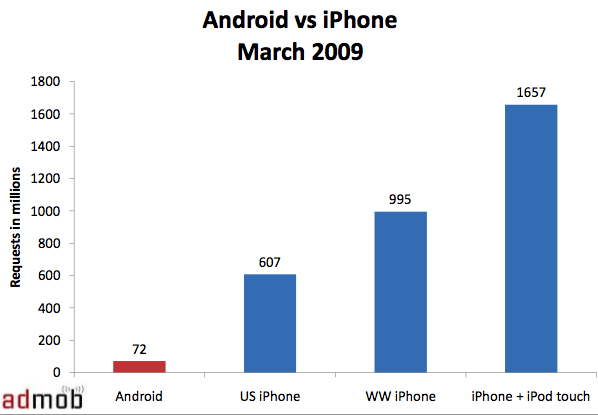
But the iPhone still dwarfs Android. As a point of comparison, AdMob measured 72 million ad requests for Android in March, 2009 versus 607 million for the iPhone in the U.S. Wordlwide, the iPhone had 995 million ad requests, and if you combine it with the iPod touch the total grows to 1.66 billion.

But is this even a fair comparison? The number of iPhones out there outnumber Android phones by nearly 20 to one (21 million iPhones have been sold to date, compared to estimates of about one million for the G1). Given these ratios, the disparity in Web usage measured by Admob makes sense. As more Android phones are introduced, that should help its numbers.

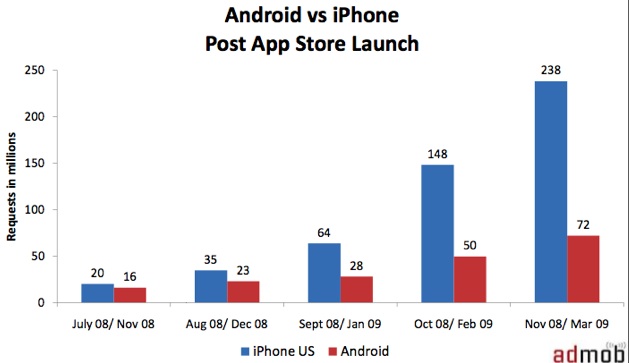
One major driver of ad requests on both platforms has been the proliferation of standalone apps. Admob measured the growth in ad requests following the launch of each app store on Android and on the iPhone, and found that the growth rate for the iPhone was 88 percent a month versus 47 percent for the Android. But both outgrew other platforms by a wide margin.

Once the Palm Pre comes out and the Blackberry App Store gains more traction, it will be interesting to see whether the relative strength of the iPhone and Android continue.

Feb 18, 2009

CLIP Apple Employees Drink the Kool-Aid; Motorola’s Don’t


In a twist on customer satisfaction surveys, Glassdoor, an online site that tracks employee satisfaction, has asked employees at mobile handset makers and carriers what they think of the executive they work for and the products and services their workplaces offer. The folks at Apple are cultishly loyal to CEO Steve Jobs, giving him a 91 percent approval rating. They like the iPhone, too, assigning it a rating of 3.8 out of five. The survey seems to indicate some correlation between good leaders (as judged by employee satisfaction) with good products — bad news for Motorola. (see the table after the jump)

glassdoor

Feb 11, 2009

CLIP Apple gearing up for $99 iPhone? Edge iPhone at Reduced Price

Ed: Original iPhone at $99 with a data-only plan would be interesting; i.e. iPod/Touch + data plan + VoIP.

Come this summer, Apple is expected to dip its toe in the entry level market for its popular iPhone, according to a report by RBC Capital Markets analyst Mike Abramsky.

(Credit: Apple)

Apple is expected to debut a $99 iPhone, as well as an iPhone 3G with updated performance, sometime in June or July, according to Abramsky's research note on Tuesday.

Abramsky, in his report, states:

Checks reveal further entry-level iPhone details, including launches on existing carriers June/July with a data plan, entry-level pricing and a lower subsidy. Also expected is a 3G iPhone performance upgrade (performance, features, form factor).

An entry level iPhone could increase Apple's overall iPhone unit sales by 25 percent to 69 percent and bump up its slice of the smartphone market from an estimated 12 percent to 14 percent to 19 percent, the report notes.

But it could come at a price.

Apple could find itself cannibalizing its iPhones/iPod business. For example, Apple would need to sell the $99 iPhones to replace the gross profits of one 3G iPhone, Abramsky notes in his report. And it could also create a situation where Apple would need to lower its iPod pricing to sustain the momentum with its media player since the iPhone also offers such capability.

To compensate for a potential cannibalization of its gross profits, the computer maker would do well by expanding its distribution beyond its current list of iPhone carriers, the analyst notes.

From Abramsky's point of view, Apple investors should remain wary.

Apple's shares have risen 16 percent since it reported record first-quarter results. While the shares could possibly go higher ahead of the iPhone update, Abramsky remains concerned that Apple is still largely a premium-priced hardware maker standing in a global recession that's acting like quicksand.

Talk of an entry level iPhone has surfaced in the past, from rumors of an iPhone Nano to a $99 iPhone at Wal-Mart.

Apple was down less than 1 percent at $97.20 a share in early morning trading, coming off a 4.6 percent decline on Tuesday when it closed at $97.83 a share.

Jan 10, 2009

Palm did what Nokia, RIM, and Microsoft couldn’t: build a better experience than Apple


from Scobleizer -- Tech geek blogger by 

When I sat down at the beginning of the Palm Pre announcement press conference I was expecting to watch the death of a company. Palm? Give me a break. It would NEVER do anything interesting and Nokia, Microsoft, RIM, and expecially Apple were about to kick it into the deathbin of history.

I was wrong. WAY WAY WAY wrong.

Palm just did what Nokia and Microsoft and RIM couldn’t do: deliver a better experience than Steve Jobs did.

“Give me a break Scoble, you are drinking the shiny new object Koolaid,” I can hear you saying.

This is why I didn’t post a blog about it all day, even though everyone else did. I wanted to let the Koolaid wear off. I went back to the Palm booth again tonight just to make sure what I saw this morning was real.

I learned even more stuff that just blew me away.

From Palm? Give me a break!

Nokia’s devices that I saw last month just suddenly seem so lame.

Why? Well, when you look at the Nokia N97, which will be out at about the same time as the Palm Pre, you see that they also have a nice UI, but it falls apart when you click down into apps and try to do things. Palm doesn’t fall apart. Click down and you keep getting shocked.

Palm’s bet on social networking integration is a game changer. Click into a contact and you see people’s Facebook info and other info from their social networks. That is huge and not many people will get it.

Palm’s web browser is easier to get around than the iPhone’s is. Dave Winer will like some of the touches that were integrated here.

Are you surfing the web and alert comes up? Your web page doesn’t disappear. Really nice touch.

Are you a developer? Everything is based on standard webstuff. Javascript. Et al.

Cut, copy, and paste. Anymore to say?

How Apple centric is the new Palm team? Well, Chris McKillop is director of Software at Palm. He worked on the iPhone team (showed me pictures of me and my son buying iPhones at the Palo Alto store). One of the PR people at Palm did PR at Apple. Jonathan Rubinstein, who runs the Palm Pre team and led off the announcement, was a key person in development of the iPod and lots of people followed him from Apple to Palm, I heard from several people today.

Here’s some videos.

Peter Skillman, director of new product experience at Palm, shows the out of box experience and how the device’s size compares to the iPhone.
A piece of the announcement event today where they showed off some of Palm Pre’s web features.
Here’s another video of Peter showing off what he thinks the coolest things about the Pre are.

Anyway, the bottom line is Palm has a real winner here. It shows that you can never count a company out. Even one that looks like it’s already out of the game.

Vertical wall sourced from Palm by Photokit

Ed: Where's the recurring revenue? Will Sprint share? Apps share? Music share?

  • Match iPhone cool: Zoom/unzoom, touch accelerometer, Wi-Fi
  • Beat iPhone: contact integration, simpler Palm Pre apps, better camera, keyboard
  • Weakness: Sprint, music
  • Unknown: video, execution on delivery
Winner - iPhone and Palm
Loser- Nokia, Motorola, WinMob, RIM 

Jan 4, 2009

What Do Google Android Netbooks Mean For Microsoft And Apple? (GOOG)

Ed: Mission critical elements for a netbook:
  • High density LCD screen with chip assisted zoom, unzoom.
  • Touch sensitive gestures - not just on/off states.
Apple owns a lot of the IP and chip technology to support the iPhone platform. Microsoft, Android, Symbian, RIM, and Palm need to invent around those patents - slowing their progress.

What Do Google Android Netbooks Mean For Microsoft And Apple? (GOOG)

 | 

acer-netbook.jpgIt's no secret that Google (GOOG) is hoping its Android operating system can be useful for more than just mobile phones. So it makes sense that Google would want to get Android on "netbook" laptops -- small, lo-fi computers that companies like Dell (DELL), HP (HPQ), Acer, and Asus are selling like hotcakes to geeks and early adopter-types.

If that happens, and Google-powered computers take off, Microsoft is the biggest loser. Early netbooks ran Linux, but today's best sellers run Windows. For instance, the 10 top-selling laptops on Amazon (AMZN) right now are netbooks running Windows XP Home. While selling an XP Home license likely isn't as valuable to Microsoft as selling a Vista Ultimate license, it'd still be losing some potential license sales. And if netbooks start cannibalizing real laptop sales, Microsoft stands to lose market share, too.

What about Apple? The company hasn't joined the netbook market yet -- unless you count the iPod touch, or maybe the iPhone -- but will supposedly start selling larger tablet computers sometime next year. We see no reason why a Google-powered netbook would necessarily be better than an Apple-powered netbook. But they could be cheaper.

So who will win? Obviously too early to tell -- most of this is theoretical. But if Google and Apple both enter the market, we think it's a positive for both companies, and a negative for Microsoft. Some thoughts:

  • It will be hard for anyone to make hardware as nice as Apple's, especially if their multi-touch technology is involved. And their OS X is still more elegant and useful than Android (and Windows, many will argue).
  • Assuming Apple's tablets can access an equivalent of the iPhone App Store, it'll be hard for Google or Microsoft to catch up quickly with similar offerings of lightweight, powerful apps. Android's app market is a disappointment so far, and Microsoft's Windows Mobile apps would be useless on netbooks.
  • It will be hard for Apple (or Microsoft) to match Google's excellent, expanding base of free Web services -- which is the core purpose of a netbook -- ranging from GMail and Google Maps to Docs, Gears, and even ane-book store
  • As long as these services run just as well on an Apple- or Microsoft-powered device as they do on a Google-based device, that's not a reason to buy a Google-powered device. However, if a special version of Google's Chrome browser is Android-exclusive, and makes Google apps much, much better, that could be an Android advantage.

It's always possible Microsoft has something up its sleeve -- the killer netbook platform, or something. But given the way they've punted so far in the next-gen mobile platform war -- Windows Mobile is weak compared to iPhone and Android -- we're not holding our breath.

Meanwhile, Google's best bet for making money still seems to be using Android as a tool to get more people using the Internet on more non-PC devices, and eventually viewing and clicking on Google ads. So... how's that mobile ad business going?

See Also:
Apple iPod Touch HD On The Way
It's Time For An Apple Tablet: Where's My iPod Touch HD?
20 Great Apps For Your New iPhone Or iPod Touch

Dec 24, 2008

CLIP: Turning Page, E-Books Start to Take Hold - Kindle, iPhone, Jetbook, Iliad, Eslick

By BRAD STONE and MOTOKO RICH

Published: December 23, 2008

Could book lovers finally be willing to switch from paper to pixels?

Alan Zale for The New York Times

Although Amazon will not disclose sales figures, the Kindle has at least lived up to its name by creating broad interest in electronic books.

The New York Times

For a decade, consumers mostly ignored electronic book devices, which were often hard to use and offered few popular items to read. But this year, in part because of the popularity ofAmazon.com’s wireless Kindle device, the e-book has started to take hold.

The $359 Kindle, which is slim, white and about the size of a trade paperback, was introduced a year ago. AlthoughAmazon will not disclose sales figures, the Kindle has at least lived up to its name by creating broad interest in electronic books. Now it is out of stock and unavailable until February. Analysts credit Oprah Winfrey, who praised the Kindle on her show in October, and blame Amazon for poor holiday planning.

The shortage is providing an opening for Sony, which embarked on an intense publicity campaign for its Reader device during the gift-buying season. The stepped-up competition may represent a coming of age for the entire idea of reading longer texts on a portable digital device.

“The perception is that e-books have been around for 10 years and haven’t done anything,” said Steve Haber, president of Sony’s digital reading division. “But it’s happening now. This is really starting to take off.”

Sony’s efforts have been overshadowed by Amazon’s. But this month it began a promotional blitz in airports, train stations and bookstores, with the ambitious goal of personally demonstrating the Reader to two million people by the end of the year.

The company’s latest model, the Reader 700, is a $400 device with a reading light and a touch screen that allows users to annotate what they are reading. Mr. Haber said Sony’s sales had tripled this holiday season over last, in part because the device is now available in the Target, Borders and Sam’s Club chains. He said Sony had sold more than 300,000 devices since the debut of the original Reader in 2006.

It is difficult to quantify the success of the Kindle, since Amazon will not disclose how many it has sold and analysts’ estimates vary widely. Peter Hildick-Smith, president of the Codex Group, a book market research company, said he believed Amazon had sold as many as 260,000 units through the beginning of October, before Ms. Winfrey’s endorsement. Others say the number could be as high as a million.

Dec 15, 2008

CLIP: Palm Pins Its Hopes on Nova

The smartphone maker debuts its new operating system, code-named Nova, at January's CES. Palm says its phones for it will bridge the BlackBerry-iPhone gap

Jon Rubinstein got the call in mid-2007 while he was living on the Pacific Coast of Mexico, working on his dream house after a storied nine-year stint at Apple (AAPL). Former Apple finance chief Fred Anderson and Silicon Valley financier Roger McNamee, partners at private equity shopElevation Partners, were considering an investment in struggling smartphone maker Palm (PALM). They wanted Rubinstein, who's known informally as "Ruby," to come aboard. Having led development of products such as the iMac and the iPod that had saved Apple from oblivion, Rubinstein thought the opportunity smelled intriguingly familiar.

A few days after getting the hard sell in person from Palm Chief Executive Officer Ed Colligan, Rubinstein agreed to become Palm's executive chairman in charge of product development (Colligan would handle the business stuff). Rubinstein's rationale was that for all its problems, Palm could still manage a comeback. It boasts a well-known brand, close ties with key phone companies, and a track record of making breakthrough products like the original Palm PDA and the Treo smartphone. The company was already working on an ambitious new operating system that would be a foundation for a wide range of useful mobile tools. With the right leadership, Palm could find a niche in a critical area for tech: mobile Internet. "The next 10 years is all about the transition from notebook to mobile computing," Rubinstein says.

AIMING FOR THE "FAT MIDDLE"

Rubinstein's efforts are about to bear their first fruits. On Jan. 8 at the Consumer Electronics Show in Las Vegas, Palm is due to unveil the long-awaited operating system, code-named Nova, as well as the first of a family of products that will run on it. While Palm has protected its plans with Apple-like secrecy, Rubinstein and others say the goal is to create products that bridge the gap between Research In Motion's (RIMM) BlackBerry devices, oriented to work and e-mail, and Apple's iPhone, oriented to fun. "People's work and personal lives are melding," Colligan says, adding that Palm is aiming for the "fat middle of the market."

Palm needs to hit its mark. The company has lost share and its stock price has plummeted 80% since Rubinstein joined. With about six quarters of cash currently in the bank, Palm's last best hope may be Nova, to be released by mid-2009. Cash-strapped carriers are loath to take on the cost of supporting another platform and software developers are busy building software for other devices, including the iPhone, BlackBerry, and phones that use Google's (GOOG)Android software. "If they can't show me a large, active audience, I'm not going to be interested," says Jeff Holden, CEO of Web 2.0 company Pelago, maker of a social networking tool for the iPhone. "At this point in the game, you're toast unless you have something completely unbelievable."

Palm insiders are optimistic. "I'm fundamentally convinced we're onto something huge," says Mike Bell, a 16-year Apple engineering star who joined Palm last year. "Some of the stuff we're working on here is mind-blowing—better than anything I've seen before."

THE ALL-AROUND SMARTPHONE

Executives won't be specific about Nova, though Palm is not looking to go toe-to-toe with the iPhone or BlackBerry. The general idea is to create a platform that's flexible enough to support a wide range of customer desires. No single product can satisfy all the unmet needs of today's digital consumers, McNamee says. Today, people carry iPods, cell phones, and Amazon.com (AMZN) Kindle e-book readers. But there's no mobile-phone software that can handle complex games like those played on a Nintendo DS handheld, or let a working parent manage both corporate e-mail and family calendars.

The iPhone comes closest to handling such divergent needs, but is so packed with features that its battery power is quickly depleted, McNamee says. "Because of power limitations, nobody dominates the whole market," he says. He believes over time, the iPhone will be the device of choice for the 10% of cell-phone users interested primarily in mobile movies and other professionally produced fare. BlackBerry will remain the go-to phone for people interested in basic communications and so RIM will command greater share in the long term. What about Palm? During an interview at Elevation's offices, McNamee declines to say how much share he expects Palm to get, when Anderson pipes in, "Two percent would be just fine." With more than a billion cell phones sold each year, every point counts.

Sources say Rubinstein's team also hopes to create phones that make smarter use of data about you. For example, your smartphone could send you an e-mail the day before your next business trip, advising you on the weather conditions in your destination city.

Palm hasn't made good on any of these promises yet. But while the company has earned a reputation for missing deadlines—analysts expected a new OS a year ago—backers note that the company's engineering corps has undergone a radical makeover under Rubinstein. The company says it's hired 150 engineers since Rubinstein's arrival. Among them are Jeff Devine, a top operations executive with Nokia (NOK), and Way Ting, an operating system guru from Silicon Graphics (SGIC). "We haven't had any trouble selling our story," says consultant Dan Walker, who was Apple's chief talent officer from 2000 to 2004 and now leads recruiting for Palm...


Palm's New Smartphone Platform Coming Jan. 8 (PALM)

 | 

treo-pro.jpgPalm (PALM) is on the brink: Its Treo smartphones, once leading the industry, are bulky and outdated. Upstarts like Apple (AAPL) and RIM (RIMM) have zipped past. And it's burning cash.

But that's okay! None of that will matter if its new smartphone platform, dubbed Nova and headed up by former Apple exec Jon Rubinstein, is a hit.

Palm, which has been promising to unveil the platform this year, will do so next month instead, Jan. 8 at the Consumer Electronics Show in Las Vegas.

BusinessWeek: While Palm has protected its plans with Apple-like secrecy, Rubinstein and others say the goal is to create products that bridge the gap between Research In Motion's BlackBerry devices, oriented to work and e-mail, and Apple's iPhone, oriented to fun. "People's work and personal lives are melding," [Palm CEO Ed] Colligan says, adding that Palm is aiming for the "fat middle of the market."

Won't be easy, but we won't write it off until we've seen it. Meanwhile, Palm will have to deal with at least one unknown variable on Jan. 8: The new goodies Apple's Steve Jobs will have announced just two days prior during his annual Macworld keynote.

See Also:
Palm's New Smartphone Platform DOA?
Frustrated Palm Investor Trolls BlackBerry's Facebook Page
Palm: Fall Sales Horrible, Slashing Costs


Palm CFO Bails Ahead Of New Platform Launch

from Silicon Alley Insider by 

Weird timing: Just as Palm (PALM) is set to launch what's supposed to be the future of the company -- a secret smartphone platform -- its CFO is leaving. Andy Brown will leave Palm in January, to be replaced by eBay (EBAY) accounting exec Douglas Jeffries.

In a note today, Citi analyst Jim Suva writes that the change doesn't signal any accounting concerns -- Brown will sign off on Palm's 10-Q. And Suva notes that the CFO change was not related to Palm's recent surprising flop -- announcing November quarter sales missed consensus by 40%. (As it shouldn't be. Palm's problems are overwhelmingly product related.)

But like Suva, we're surprised by the timing. If Nova, the new smartphone platform, is really the future of the company, it seems a strange time to leave.

Meanwhile, in the same vein as Apple (AAPL) and Google (GOOG), Palm is releasing an App Storefor its Palm OS and Windows Mobile-based smartphones. Smart move -- installing apps on Palm smartphones used to be a pain.
Dec 3, 2008

Stores Clueless About Mobile Barcode Scanning Applications?

Stores Clueless About Mobile Barcode Scanning Applications?

scanning_barcodeWith the rise of app-laden smartphones like the iPhone and Google's Android OS, now on T-Mobile's G1, many penny-pinching shoppers have downloaded barcode scanning applications onto their mobile devices. These apps allow consumers to compare the prices of merchandise on a store's shelf to competing stores in the area just by taking pictures with their smartphone's camera. The prices are instantly retrieved and displayed on the mobile phone so consumers can know before they buy if they're getting a good deal.
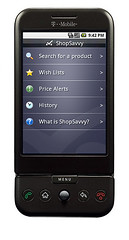
Although consumers may be catching on to this barcode-scanning trend, some stores are still in the dark. For example, a Target store in Michigan recently requested a shopper to stop scanning merchandise, saying it went against store policy. The customer reported the event to the application's makers, Big in Japan, whose app Shop Savvy is a popular download for Android handsets.

Big in Japan called the Target store in question and spoke to the manager, who indicated that she was not aware of the policy. We also contacted Target's corporate headquarters to confirm Target's policy, or lack thereof, but we first had to explain the application to the company representative. They had never heard of such a thing before! (As it turns out, Target has no policy whatsoever on barcode scanning their merchandise.)

The same customer also noted they had visited Sam's Club, where they demonstrated the application to a store employee who seemed "confounded that such technology even existed," wrote the user.

Instant Price Match Is Retail's Future

shopsavvyAlthough this is just anecdotal evidence from one customer, it's entirely believable that without concrete store policies in place, you're going to encounter rogue employees here and there who have no idea what you're doing and will ask you to stop.

On the flip side, stores that do get hip to this trend may decide to implement store policies that ban scanning, once they realize that customers could discover their high prices. A post on AdLab for example, a blog about advertising and marketing, suggests retailers do just that. They also recommend retailers should consider investing in a a cell phone jammer. They even provide a "No iPhones on Premises" sign for printout.

That doesn't seem to be a very proactive way of dealing with the technology. In fact, it reminds us of how both the music and movie industry attempted to quash the pirating of songs and films: they just tried to make it stop. Instead of going a route destined for failure and trying to shut down barcode scanning altogether, retailers could choose to embrace the trend. They could offer easy-to-find barcodes on their promotional items with signage encouraging customers to compare the price instantly with other stores in the area. They could make barcode scanning the new advertising circular.

Hopefully, stories like those of the Shop Savvy customer will remain isolated incidents and no other store employees will bother customers looking to save money. If you've used barcode scanning applications and have experiences to share, please let us know in the comments.


Nov 12, 2008

Is Facebook the mobile web’s killer app? Is sharing the future of the web?

Is Facebook the mobile web’s killer app?

Posted by Steve O'Hear @ 8:29 am

Active users of Facebook’s various mobile products has grown from 5 million to 15 million since the beginning of the year, says the company. In particular, the ability for users to not only update their ’status’ while on the go but also to comment on their friends’ updates, has spurred mobile use of the site.

“When we recently added the ability to comment on your friends’ status updates to the Facebook mobile site, we didn’t expect that we would receive nearly a million status comments in the first 24 hours”, writes Facebook’s Wayne Chang on the company’s official blog.

While that particular tidbit is interesting, it should be no surprise that mobile versions of Facebook are proving popular. Not when you take into account that Facebook offers two browser-based mobile versions of the site — one for low-end feature phones and another for ’smart phones’ — as well as native Facebook clients for Blackberry, Palm and iPhone. Notably, the Palm version runs on the smartphone maker’s entry level consumeroffering, the popular and affordable Centro. While television ad campaigns that aim to push the Blackberry beyond its business roots and into the hands of consumers pitch Facebook access as a major selling point. Ditto some of the most recent ad campaigns for Apple’s iPhone.

See also: BlueWhaleMail: Facebook messages “pushed” to your cellphone

And it’s not just high end smartphones that are getting their own Facebook client application.  As I wrote over at last100, a new low cost cellphone that puts Facebook and other social applications at its center will debut this week on Hutchinson-owned 3 in the UK and Australia. The new handset has been designed by another Hutchinson subsidiary, INQ Mobile, and is the first of a number of “low cost social mobile” offerings in the pipeline. INQ has been working directly with Facebook in order to offer better integration than is available on existing low end handsets.

Handset makers clearly see Facebook as a way to sell more phones but what’s in it for the carriers? Aside from picking up or retaining subscribers, the telcos hope to get more people using the mobile web in order to sell more data.

“For 85 percent of our customers, we can’t really sell more than voice and text,” INQ Mobile’s CEO, Frank Meehan, told Unstrung. “You need to drive data usage higher right across all the handset segments. You want the majority of customers, not the top-end of the community that rules strategy at the moment.”

See also: Snap2Face: Facebook lands on Windows Mobile

Facebook Mobile Sees 3X Growth to 15 Million Users This Year

Facebook announced last night that the company has seen users of its mobile site, m.facebook.com, jump from 5 million to 15 million this year. The most recent change made to the site, allowing comments to be posted on status messages from your phone, resulted in more than 1 million mobile posts in the first 24 hours.

While these numbers are still relatively small compared to the total number of Facebook users (under 10%), it's huge for mobile social networking. Facebook has a really good mobile site and it looks like it's only getting better.

Context

Facebook Mobile is now probably bigger than the entire userbase of Mixi, Japan's leading social network and a site that is very frequently accessed by mobile. Last week 6 leading Japanese social networks, including Mixi, MySpace Japan, Yahoo and others, announced that the companies are forming a mysterious alliance that could include content and widget sharing across their mobile sites.

We're curious how that kind of strategy will work compared to Facebook's strategy of building up a huge siloed web based social network and then creating a simple but extremely usable mobile version.

Zuckerberg’s Law of Information Sharing

Mark ZuckerbergMark Zuckerberg, founder of Facebook. (Credit: Craig Ruttle/AP)

On stage at the Web 2.0 Summit on Thursday, Mark Zuckerberg, the chief executive of Facebook, was cheerfully unruffled.

Mr. Zuckerberg pinned his optimism on a change in behavior among Internet users: that they are ever more willing to tell others what they are doing, who their friends are, and even what they look like as they crawl home from the fraternity party.

“I would expect that next year, people will share twice as much information as they share this year, and next year, they will be sharing twice as much as they did the year before,” he said. “That means that people are using Facebook, and the applications and the ecosystem, more and more.”

Call it Zuckerberg’s Law.

Mr. Zuckerberg is too low-key to compare his observation to the law first articulated by Gordon E. Moore, the co-founder of Intel, that the number of transistors on a chip doubles every two years.

But if it turns out to be accurate, Mr. Zuckerberg’s prediction may turn out to be just as important to society.

And if Facebook is even half as good at exploiting Zuckerberg’s Law as Intel was at exploiting Moore’s Law, Mr. Zuckerberg will be a very happy man indeed.


Oct 29, 2008

Motorola Betting Big On Google's Android To Take On Apple, Rivals

Ed: Motorola, Nokia, Sony, Samsung, and the Taiwan companies need to learn that the cell phone is no longer just a low-price, hardware business. 

  • Companies like Apple, RIM, and Palm have converted into an integrated SaaS offering. 
  • It won't be long before web 2.0 tools for social media become a necessary part of the business. 
  • Microsoft will enter, when it is too late to build.
Entrepreneurs, ramp up and get sold. 

Motorola Betting Big On Google's Android To Take On Apple, Rivals

Motorola (MOT) continues to overhaul its depleted cellphone division under new CEO Sanjay Jha, who came over from Qualcomm (QCOM) this summer. Among the big changes, which the Wall Street Journal says could be detailed during the company's Q3 earnings call Thursday morning:

  • Thousands of layoffs.
  • A new mobile phone strategy that includes betting big on Google's (GOOG) Android mobile operating system.

The Journal says Motorola will stop working on several mobile operating systems (and could cancel dozens of phone designs) to focus on three platforms: Android for consumer-focused phones, Microsoft's Windows Mobile for business-focused phones, and an internal platform for lower-end phones.

This sounds smart to us. Android, while not as elegant as Apple's industry-best iPhone software, is equally as powerful -- and with some software and user interface updates, matched with good hardware, could be a strong mobile platform. (Certainly as good or better than anything else Motorola has shipped recently.) Windows Mobile needs work, but it can handle enterprise stuff pretty well, which Android doesn't yet.

One thing that could be tricky to juggle: Making Motorola's flavor of Android unique (and good) enough that its phones don't simply become a hardware commodity, while still allowing them to run apps designed for other Android phones.

What this also means: AT&T (T) and Verizon Wireless (VZ), the two biggest U.S. wireless carriers, will eventually have to suck it up and start selling Google-powered phones. So far no. 4 T-Mobile (DT) is the only U.S. carrier to sell an Android phone, while no. 3 Sprint Nextel (S) eagerly awaits theirs.

Motorola Speed Dials Cell Overhaul

New Mobile Chief Plans to Slash More Jobs, Focus on Google Software to Simplify Design and Cut Costs

Motorola Inc.'s new cellphone chief is moving quickly to scale back the struggling division, simplifying the way it makes devices and cutting additional jobs.

Sanjay Jha, who also became Motorola's co-chief executive in August, has decided to focus on Google Inc.'s Android operating system as the software platform for Motorola's showcase phones, according to people familiar with the matter.

Mr. Jha is expected to detail his plans -- which will likely include thousands of layoffs -- as early as Thursday when the company reports earnings, these people said.

The company has announced 10,000 job cuts since early last year. Motorola ...


Will Motorola Go All-In On Android? It Has No Other Choice.

Motorola’s new co-CEO Sanjay Jha has a plan to save the beleaguered mobile handset maker: go all-in on Google’s Android mobile operating system. According to a report in the Wall Street Journal (behind the pay wall):

Sanjay Jha, who also became Motorola’s co-chief executive in August, has decided to focus on Google Inc.’s Android operating system as the software platform for Motorola’s showcase phones, according to people familiar with the matter.

Mr. Jha is expected to detail his plans — which will likely include thousands of layoffs — as early as Thursday when the company reports earnings, these people said.

The rumor is that Motorola will focus all of its efforts around three core operating systems for its phones, with Android becoming the central platform for “mid-tier” phones with Internet capability. The other two operating systems it will support will be Windows Mobile on the high end and its own P2K on the low end. In other words, Android phones will become its bread and butter.

Given this potential strategy, the 350-person Android team that Motorola is recruiting while it considers another massive round of layoffs elsewhere makes more sense. It’s Android-powered social networking phone looks like it will be the first of a long line of Internet-capable phones.

Betting the farm on Android would be a gutsy move, as it is still an unproven operating system. And, as Om points out, it could be too little, too late for Motorola’s cell phone business, which has not turned a profit since late 2006...

Support Our Sponsors: