[ About Us | Popular | Marcom | AdNet | IChannel | Glossary ]
Showing posts with label AdNet. Show all posts

Mar 16, 2009

U.K. Online Ad Spend Up 17% in Q4, but Growth Slowing

from ClickZ News Blog

clickz_ukandeu.gifU.K. ad spend declined across all mediums besides online during the fourth quarter of 2008, according to numbers released today by the World Advertising Research Center on behalf of the Advertising Association.

Despite advertiser cutbacks, the report states that online achieved a 17.3 percent year-on-year increase in spend during Q4 - substantial growth when compared with newspaper spend which suffered a 12 percent fall, and TV which accrued a 4.9 percent decrease. Online growth did slow dramatically, however, falling from a 39.5 percent increase between Q4 '06 and Q4 '07.

Overall, total U.K. ad spend fell by 3.9 percent in 2008, while spending in Q4 recorded a decline of 9.6 percent year-on-year.


Twitter and UK newspaper websites

from Hitwise Intelligence - Analyst Weblogs by 

Last week (w/e 14/03/09) Twitter.com was the 54th most visited website in the UK, up from 66th the week before. One consequence of Twitter rapid rise up the rankings is that the micro-blogging service has now overtaken most of the UK newspapers online. As the chart below illustrates, last week Twitter received more UK Internet visits than the homepages of the Guardian, Times, Sun and Telegraph. It also over took Google News UK. Of the main newspaper homepages, only the Daily Mail received more UK Internet visits than Twitter last week.

UK_Internet_traffic_to_Twitter_Google_news_newspaper_websites_2009_chart.png

There are few caveats here, the first relating to how we categorize newspaper websites within Hitwise. Wherever possible we split out topic specific domains for the newspapers, particularly the broadsheets (e.g. Times Online - Business, Telegraph Sport, Technology Guardian, etc.). Consequently the traffic illustrated in the chart above refers only to the newspapers’ main homepages; although in every case these do receive the majority each title’s visits.

However, it is also important to point out that we are only measuring traffic to the Twitter homepage and not hits via third party applications such as Tweetdeck or Twitterrific. Given that some people claim that these exceed the direct hits via the website, it is also fair to say that actual Twitter usage is higher than our numbers imply. Therefore, even taking all of these caveats into accounts, the trend is clear: in the UK, Twitter now receives more UK Internet traffic than most of the main newspaper websites and is growing at a faster rate.

Although Twitter is a news source for many, it is also a source of traffic for news websites. During February, 9.6% of Twitter’s downstream traffic went to News and Media websites, and 41% of that went to the News and Media – Print sub-category, which is dominated by the newspaper sites. The chart below illustrates the top News and Media – Print websites to receive traffic from Twitter over the last year. As you can see, the Guardian currently receives more traffic than any of its competitors. And not only is its homepage the top recipient of Twitter traffic, but three of its sections (Technology, Comment is Free, and Media) also appear in the top 10.

Mar 13, 2009

CLIP Ad Spending Continues 2009 Spiral, Forecasts Slightly Better for 2010

Advertising spending continues in a downward spiral this year and will drop 12% in 2009, although signs indicate there may be somewhat of a leveling off in 2010, according to a recently released Media Business Report from Jack Myers.com Media Network.

The Myers report predicts a double-digit drop in total ad spending in 2009, following a 4% decline last year. It also projects this decline to continue into 2010, with a 5% dip for the full year, albeit off of a smaller base.

Newspaper advertising will among the hardest hit this year, with a 22.5% decline, on top of a 17% drop last year, the report said. This decline will be surpassed only by an expected drop of 25% in local, regional and spot cable TV ad buying. Other media to be hard hit include print Yellow Pages, terrestrial radio and magazines.

Among the brightest spots will be video game and mobile advertising, which Myers projects will grow 12% and 9% this year, respectively. Other resilient categories include online video/social networks (8.6%), online search (7%), branded entertainment/product placement (4%) and satellite radio (3%), according to Myers data.

US advertising peaked at $234.7 billion in 2007, up 3% from 2006, according to Reuters. In 2010, domestic ad spending is expected to dip to $187.7 billion.

Myers’ projections are based on fourth quarter 2008 and first quarter 2009 spending, GDP data and a study of the top 100 advertisers by Goldman Sachs, as well as industry analysis, according to a Reuters story on the report.

In related news, Barclay’s Capital revised its previous advertising revenue estimates, forecasting that US ad revenue will drop 13% this year, but improve to a decline of just 1.5% in 2010. Previous estimates called for an ad-revenue decrease of 10% in 2009 and a gain of 1% in 2010.

Feb 11, 2009

CLIP It's Been A Year Since AOL's Big Widget Play, But How Real Is The 'Widget Economy'?


imageThis time last year, VC firms had already invested nearly $60 million into widget-related companieslike Slide and WidgetBox. AOL got caught up in the widget craze too, and gobbled up desktop and web app-maker Goowy Media. Was it a hasty investment—like the one the company admitted it made when it bought out Bebo for $850 million during the social media rush the previous year?
More on that later ... In the year since that acquisition, VCs have continued to invest in widget-related companies, with nearly $13 million worth of funding for startups like iWidgets, mEgo and SocialMedia in the past four weeks. And the apps have evolved from profile badges, to branded units that let users play games and videos, to price-comparison tools. But analysts are still expecting a shakeout, as advertisers are cutting back their budgets across the board, and investment firms are scrutinizing the business models of startups (and even established companies) on the hunt for cash. More after the jump.

—But how real is the widget economy?: The latest forecast from eMarketer only pegs widget- and app-based social media spending to reach $70 million this year—less than 6 percent of the $1.3 billion advertisers are slated to spend on social media overall. eMarketer Senior Analyst Debra Aho Williamson said the notion of a "widget economy"—at least one like last year's, with sky-high valuations for startups that aren't profitable yet—had no basis anymore. "This is still a developing market, and most of the companies are spending their resources on making the widgets smarter, more intuitive and improving their tracking capabilities," Williamson said. "Are many of them making a profit? I'd tend to say no."

—Widgets are evolving to better meet advertisers' needs: CNET, for example, partnered with Gigya to launch widgets that give tech junkies the ability to embed product reviews and video clips, and even a software downloader into their social media profiles and blogs. The apps are continuously updated—and since they're tied to products, they go beyond the glut of widgets that just look pretty or thrive on novelty (like throwing a sheep or a thong at your friend) that quickly wears thin. "Last year it was about the rush to just 'do a widget' that's fun but didn't have much use," Williamson said. "Advertisers have decided that they need to be more than just fun—they need to serve a purpose. If you can provide real-time pricing info on a product right on a review site, that's an interesting model."

—The shakeout is still coming: "There's going to be consolidation across the space, simply because there's only so much real estate on someone's social networking page," William said. "There are already thousands of Facebook apps available, and only a few that are going to do really well." Companies like Gigya, WidgetBucks and others that build in-depth analytics and other features into their widgets may survive, but a majority of the app development and distribution startups won't if they don't get more cash—or get acquired. Williamson also said some of the widget funding and development market might "siphon off to the iPhone," as startups take what they've learned (and their investors) and port it to mobile app development.

As for AOL (NYSE: TWX), the company folded Goowy into its Platform-A business in July, and then pulled the plug on the Yourminis customizable start pages—a feature the startup had been known for—so that Goowy could focus on developing brand-friendly widgets. According to a release touting the deal's one-year anniversary, Goowy widgets powered nearly 2 billion impressions over the course of 2008—but AOL didn't disclose the average CPMs for its widget ads. Since the company has to split that revenue with publishers (and display ad revs were down 25 percent in Q4), it's quite possible that the investment may not be as lucrative as they're making it out to be.

Related

Feb 5, 2009

STATS Is The Worst Behind Us? Online Ad Revenues Pick Up In The Fourth Quarter.

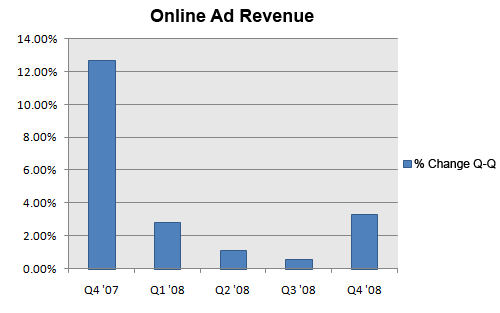
With Time Warner reporting earnings yesterday, we now have online advertising numbers for the fourth quarter from the four largest players: Google, Yahoo, Microsoft, and AOL. Tallying up their online advertising revenues provides a decent proxy for the health of the overall online advertising industry as a whole, since they represent a majority of those revenues. (For comparison, see IAB numbers for the U.S. only).  After a full year of slowing growth, their combined ad revenues actually picked up in the fourth quarter, showing a 3 percent rise compared to the third quarter. Combined revenues grew 8 percent on an annual basis.

Like everyone else, I’ve been expecting to see continuing pressure on Internet advertising. In the third quarter, the sequential growth of the combined ad revenues from these four companies ground to a halt, going from 12.7 percent sequential growth in the fourth quarter of 2007 to 0.6 percent in the third.  (All growth rates are quarter over quarter, unless otherwise noted).

What the slight rebound in growth tells us is that search advertising may be making up for the continued weakness in display advertising, which each of these companies acknowledged in their conference calls.  The question is whether sequential growth will remain in this low range for the rest of the year, or whether search advertising can push it higher. One quarter’s worth of data is not enough to make any conclusons on that front, but at least these numbers provide a ray of hope.

The combined ad revenues totaled $8.5 billion in the fourth quarter, up from $8.2 billion in the third quarter and $7.8 billion in the fourth quarter of 2007. Google continued to dominate, accounting for 65 percent of those revenues, up from 61 percent from a year ago but slightly down from its 65.3 percent share in the third quarter.  Google contributed slightly more than half of the growth.  Yahoo’s 19.1 percent share of revenues went up quarter-over-quarter by the same amount that Google’s went down (0.3 percent).  Microsoft’s $866 million in online revenues gave it a 10.2 share, up from 9.4 percent in the third quarter.  And AOL’s advertising revenues remained flat at $507 million, giving it a 6.0 percent share (down 0.2 percent).

For the purposes of this analysis, I took the total advertising revenues from both Google and Yahoo, including their network revenues paid to affiliates, the online revenues reported by Microsoft, and only the advertising portion of AOL’s revenues. The revenue share figures above are rounded. Below are the absolute revenue numbers, broken down by company:

Jan 17, 2009

CLIP Federated Media Shifts Away From Display Ads; Restructuring Includes Some Job Cuts


imageFederated Media is meeting with its staff now to tell them about a decision to move the company away from display advertising and devote more resources to conversational marketing, paidContent has learned. The company is cutting seven jobs in the display area but publisher and chief revenue officer Chas Edwards (right) tells us FM has added some 25 jobs since July 1 and continues to hire. FM will have about 80 people on staff following the layoffs.

Edwards said when the company reached out to advertisers about their coming needs in the tough economy, small advertisers said they would be disappearing for 12-18 months while larger companies—Fortune 500 and the megabrands—- said: "Our competitors are going to be under a rock for the next 18 months—maybe 12; we're going to take 2009 to steal market share but we're going to do it for less. ... We're not going to do dumb display advertising on the internet, buying display banners through ad networks." The interest was more in conversation marketing and that's where FM is putting its resources, expanding the part of sales that focuses on major accounts and the back-office operations to support them.

Edwards shies away from descriptions of FM as an ad network. "As an ad network, FM is a failure. We're not organized to sell a lot of broad-based banner campaigns across zillions of sites. The approach we take is more of a publisher with a portfolio." FM, which represents more than 150 websites, partners with ad networks to sell remnant inventory.

Much more after the jump

—Revenues: Edwards spoke in broad terms about revenues: "'08 wraps up around $39-40 million in revenues, up 70-80 percent from 2007. We still had a pretty good year of growth, although we had a pretty crappy Q4 like everyone else." Even so, he's projecting 2009 will be up somewhere between 35-50 percent. When I asked why he was so optimistic in such a down time, he responded, "I think the online market overall is going to be flat. The reason we have this optimism is the conversation we're having with marketers. We're coming off of frankly, a pretty small base of revenue in the overall scheme of things." He thinks FM will take advantage of what he expects to be a migration from print during the recession.

Chairman and CEO John Battelle explained the decision in a post on the company blog that went live during the meeting.

Update: Over at TechCrunch, Mike Arrington says he's worried about his company's relationship with FM, which accounts for a third of his company's income, and, though he says the decision is up to CEO Heather Harde, wonders out loud if it's time for a new ad partner. Payments have dipped recently and he contends that staying with FM is more costly: "The biggest issue is that as a market leader among tech blogs, we end up subsidizing others. An example - an advertiser comes to us with, say, a $100,000 spend. They are referred through to Federated, who if they make the sale gets a 40% cut. That cut is fine. But what Federated then does is spread that $100k around to many different blogs. In the end we may only see a small fraction of it spent on TechCrunch." Battelle tells him FM will be focusinbg more on the kind of advertising that;s good for TC.

Justin Davis counters, saying he likes the way FM reps his four sites (Modojo.com, Destructoid.com, Gamersyde.com, and GoNintendo.com): "Mike… you're so dramatic, sometimes. FM makes it EXTREMELY easy for the sites they represent to follow up on leads themselves. They literally have a whole self-serve platform set up you can point ad buyers to, and if they place an ad buy, #1 it doesn't get split with a half-dozen other sites and #2 FM doesn't take it's 40% split - it takes 10% for serving the ads."

Jan 11, 2009

CLIP Local Advertising Booster Yodle Growing Like A Weed, Raises $10 Million

Ed: Web services, search advertising, optimizing, tracking.

Yodle, the New York-based startup that helps local businesses advertise more efficiently on the web, has secured $10 million in Series C financing in a round led by JAFCO Ventures and joined by Draper Fisher Jurvetson Growth, DFJ and Bessemer venture Partners. The company took the opportunity to add some facts and figures to the funding announcement, and they reflect that Yodle is doing quite well, thanks for asking.

The company, which started out in 2005, reports a whopping 700 % increase in annual revenue compared to its 2007 income. Of course, expressing growth in percentages is meaningless without actual figures, so we poked around a bit and got CEO Court Cunningham to at least share the run rate for last quarter (Q4 2008), which amounts up to $30 million. Also telling is the reported growth in employee count and signed customers: Yodle had 9 people on the payroll in 2006, it now has about 250, and the company now boasts 5,000+ customers which is up from 125 in 2006. Yodle expects to turn a profit in about six months.

In essence, Yodle is a lead generation company focused on aiding small businesses advertise their wares in search results for all major search engines. If customers have a website, the ad will point directly to it and Yodle will track and optimize actions starting from clickthrough to phone calls, etc. If there’s no web presence yet, the small business can opt to work with Yodle to create a custom so-called AdverSite which acts as a basic call-to-action website or landing page for the advertisers. Pricing for Yodle’s suite of services includes keyword bid management and optimization, website / landing page creation, and analytics ranges from under $1000 for small local business owners to over $5000 for larger businesses.

We understand that Yodle is quite persistent in generating a constant stream of new customers by using aggressive sales techniques, to the extent of local small business owners threatening to sue the company for harassment. Cunningham didn’t exactly dismiss these claims, but stated the whole thing concerns questionable methods used by isolated sales representatives who tend to “end up having a short career at Yodle”.

Yodle competes against a number of similar, venture-backed companies such as ReachLocal (which raised a substantial $65 million in funding to date), MerchantCircle (which raised its $10 million in Series B funding round in November 2007), Ingenio (acquired by AT&T, also in November 2007), WebVisible (total funding: $17 million) and a plethora of smaller companies trying to get their piece of the pie.

Jan 8, 2009

CLIP @ CES: Online Video Exec: 'If We Don't Do Things Differently, The Industry Is Screwed'

from paidContent.org by 

imageOnline video viewing continues to surge, but the ad dollars flowing into the space still aren't scaling accordingly. Panelists at the Reinventing Advertising Conference @ CES trotted out well-worn reasons for that imbalance: lack of standard metrics; high volume of low-quality content; building the right amount of reach, etc. But Brian Terkelsen, EVP and managing director at MediaVest's connectivetissue, (pictured) avoided the hand-wringing and laid it on the line: "Advertisers aren't being aggressive enough in general—they helped grow TV to where it is now, so I think it's partly up to them to drive video. If we don't challenge the industry to do things differently, we're screwed."

BitGravity CEO Perry Wu said time was already up for many of the smaller online video development and distribution studios: "We work with hundreds of content companies and to be honest, many of them won't survive. Indie sites that have premium news or sports content and a targeted audience can prove that they're valuable to advertisers—but some of the broad, more generalized companies will have a harder time."

Even larger video publishers like cable networks are at a crossroads of sorts. Steve Ronson, A&E's EVP, Enterprises, said the company is struggling to figure out how to make enough money from porting its "premium on air content" to the Web. "Do we run outtakes? Show snippets? Do we run long form but not cream of the crop?" he said. On some levels it doesn't have a choice, since viewers clearly want to access their favorite shows online—but Ronson said getting it to the Web sans the "millions of dollars worth of TV ads" is a "troubling issue." He added that many networks were weighing the ad-supported vs. subscription model or some hybrid of the two. (And with brand advertisers cutting budgets across the board, that subscription model is looking more and more lucrative.)

The rest of our coverage is on our CES 2009 channel

Jan 6, 2009

CLIP: JP Morgan Sees Long-Term Dominance For Performance-based Ads; Online Video Loses Luster

Ed: 

  • Online advertising is still growth market, but slower growth.
  • CPC is preferred to CPM
  • Embedded video ads can't predict views, nor actions - like event-oriented sites
  • Social network is horizontal - too many competitors delivering the same product

It's not surprising that during a downturn, the clear metrics and ROI offered by performance based ads are looking more attractive. But in his wide-ranging '09 outlook, JP Morgan analyst Imran Khan expects marketers to treasure performance-based ads even when the larger economy begins to grow again. So the market share gains that performance ads have achieved over the CPM-based model look pretty durable and mean continued struggles for display ads.

The report, Nothing But Net: Outlook for Global Internet Stocks in 2009 (PDF), predicts that the mostly performance-based U.S. search ad market will rise 10 percent in 2009 to nearly $16 billion. In contrast, display ads, which includes both performance and branded advertising, will grow only 6.3 percent to $8.4 billion this year.

—Bearish online video: Khan expects the accelerated shift to performance ads having a dampening effect on the growth of online video ads. Even in a series of downward revisions, online video ad growth still seemed poised for healthy gains this year. For example, at the end of November, eMarketer forecast online video growth of 44.9 percent, which was still nearly half of the 81 percent growth rate the researcher predicted for 2008. Khan believes that online video is headed for a considerable slowdown because one, it's still reliant on the CPM model, as opposed to performance-based measurements like cost-per-click or cost-per-action based display. And unlike television, which still can count on advertisers to respond to CPMs, online video can't guarantee viewership for any specific video the way TV does in the upfront model. Plus, considering the unpredictability of popular videos, the uneven quality, and the continued battles over copyright, JP Morgan doesn't expect online video to have great prospects for the next few years. However, Khan is intrigued by Google's experiments with an e-commerce platform—i.e, performance-based model—for YouTube videos. For example, if a user watches a song featured in a music video, they can click on a link that lets them buy music directly Amazon (NSDQ: AMZN) and iTunes, with YouTube getting a cut of the revenue. More after the jump

—Social nets need new approach: Looking at the projected slump in online ad sales for sites like Facebook and MySpace, JP Morgan strongly advises that online communities look for sources other than display for revenue. In particular, the report offers a few possible routes to profitability, including greater use of cost-per-action ads, lead gen, sales of virtual items, connecting to classifieds or e-commerce sites, and charging for premium membership, as LinkedIn and Classmates do.

—Mobile looks good long-term:  But as for the near-term, the long-awaited explosion for mobile ads will simply have to wait for a better economic environment—not to mention better phones and technology, Khan says. although mobile phone penetration is high at 84 percent in the U.S., the mobile search market is in the early adoption stage. In Q108, only 15.6 percent of wireless subs were using mobile web, according to Nielsen Mobile data. Even within this small subset of mobile internet users, usage drastically trails that on PCs. Nielsen Online says that a PC online user visits more than 100 domains per month, whereas mobile web users visit 6.4 individual sites per month, on average.

—M&As start slow, but gather steam in H209:  With last year's total deal count down by 20 percent, according to a report last week from DeSilva + Phillips (disclosure: one of our sponsors), JP Morgan anticipates continued coolness in the acquisitions area for at least the first six months of 2009. But things are likely to heat up in the second half of the year, assuming the economy begins to stabilize.

Dec 15, 2008

CLIP: NetShelter raises $11.1 million for online media network

NetShelter Technology Media is announcing today that it’s raised $11.1 million in a first round of funding as the nine-year-old ad network for tech properties seeks to expand the reach of its 150 technology content web sites.

Backers include Montreal-based Rho Canada, GrowthWorks Canadian Fund and JLA Ventures. The Toronto, Canada-based company runs web sites such as TopTechGifts.com and LastGadgetStanding.com. The company’s vertical network strategy resembles that of Glam Media, which owns a bunch of fashion-oriented sites that can be collectively pitched to fashion advertisers.

The aggregation of the sites — in what the company calls the NetShelter Branded Network — lets tech-oriented marketers advertise directly to an affluent and passionate tech audience. That audience of 17.7 million unique visitors a month in the U.S. and 50 million worldwide is now bigger than that of CBS’ CNET online tech news site, as well as tech sites owned by media companies IDG, Ziff Davis and CMP.

Similar to companies such as Federated Media, the company is one of the necessary ingredients in how smaller web sites can attract big advertisers who advertise across an entire group of web sites that share similar audiences.

While Federated Media (which provides ads to VentureBeat) has a lot of news sites, NetShelter focuses on sites that have a lot of technical discussion about products in reader forums. Those sites include Geek.com, PhoneScoop.com, TecheBlog.com, Bytes.com, SlashGear.com, PhotographyBlog.com, CrackBerry.com, TGDaily.com, and HowardForums.com. The contrast with CNET is that no single site accounts for more than 5 percent of the traffic on NetShelter’s network.

The company was founded in 1999 by two brothers — Peyman and Pirouz Nilforoush — in the basement of a Toronto office with a few thousand dollars of savings. The original business provided web hosting service for a variety of publisher sites focused on four vertical topics — gaming, entertainment, music and technology — in exchange for ad space and revenue sharing. The company exited the hosting business and focused entirely on ad representation. Since technology was the only vertical generating ads early on, the company dropped the other three topics.

The site has been profitable from the start and it added large numbers of sites which reaped the benefits of its ad network. In 2004, the company started seeing strong growth and advertising from companies such as Microsoft. In May 2006, the company started a branded network that let tech advertisers target ads to users of sites such as Geek.com, PhoneScoop.com, TheInquirer.net. Since that time, traffic has grown 900 percent and it has doubled its revenues in both 2007 and 2008.

In February, the company changed its name from NetShelter to NetShelter Technology Media. In May, 30-year media veteran Patrick Houston became chief publisher. In December, the company said it overtook CNET for the first time in U.S. online audience, according to comScore Media Metrix.

Before today’s investment, it had previously raised just $1.5 million in seed funding. Jeff Grammer of Rho Canada, Roger Chabra of GrowthWorks, and Rick Segal of JLA Ventures have joined NetShelter’s board. The company has 35 employees and has just opened offices in New York and San Francisco.

Dec 6, 2008

No Improvement for ‘Standard’ Online Advertising

borrell-associates-change-national-local-standard-ad-format-spending-q3-2008.jpg

No Improvement on Horizon for ‘Standard’ Online Advertising

A slow-to-no growth forecast in the US for “standard” components of the interactive advertising market - such as banner, display and pop-up ads - is not cyclical and shows no signs of improving quickly, even if the nation’s economy starts to move upward and out of recession, according to a forecast report from Borrell Associates.

borrell-associates-change-national-local-standard-ad-format-spending-q3-2008.jpg

Though the report projects that overall 2009 spending on traditional, offline media will decline 1.4%, and spending on interactive will increase 7.2 %, it notes that these figures do not tell the whole story.

In fact, 2009 will be the first year since the start of century in which banners, pop-ups, and interactive display advertising overall will show little or no growth, and may likely decline.

For local interactive media, the big slowdown began a year earlier than Borell initially anticipated, magnified and accelerated by the credit crisis. The spending levels by local advertisers - which grew at a frenetic 47% this year - are expected to slow to a paltry 8% in 2009.

borrell-associates-local-interactive-ad-spending-slows-down-q3-2008.jpg

Local media companies projecting double-digit and even triple-digit increases in their interactive budgets next year will have a very difficult time meeting those expectations - especially if they rely on banner ads, the report said, adding that as new advertisers move to the web, they will be less enthusiastic about spending their newly-shrunken ad budgets on traditional formats that they perceive to be less effective.

Future dollars are likely to be spent on other forms of interactive advertising, such as email, paid search and streaming video - which is expected to see the biggest spending growth, according to Borrell.

The report, “2009 Outlook: Big Slowdown Begins For Interactive Advertising,” which is available for purchase, includes national forecasts for US media revenue and spending, detailed analysis of the credit-crisis impact on media revenue and spending, and projections for growth and spending on promotional advertising.

Nov 22, 2008

Gigaom Network Parting Ways With Federated; Going With IDG's Tech Ad Network

Gigaom Network Parting Ways With Federated; Going With IDG's Tech Ad Network

Gigaomni Media (GOM), the parent company of the popular network of tech sites including Gigaom, is parting ways with its long time ad partnerFederated Media, and moving to a more enterprise-focused IDG TechNetwork, IDG's tech ad network, we have learned and confirmed from the two companies. The new deal with IDG is for all CPM-based online advertising across GOM's network of seven sites, and the company will still sell events and online sponsorships directly on its own.

While this is not a significant monetary setback for Federated, it does point to what the John Battelle-founded online-ad company is giving up as it continues to scale: Its focus has been on large-scale national advertisers and creating both general and custom programs with them, as opposed to the more 'intimate" sells required for enterprise-focused vendors that GOM attracts. FM has a big-brand focus, for most part, and beyond its early start with tech sites, it has now moved into all kinds of other verticals like parenting, food, graphic arts, small business and others.

Gigaom founder Om Malik has previously publicly disagreed with some aspects of FM's "conversational marketing" approach with some tech advertisers. And while that did lead to some tension last year, I spoke to both Chas Edwards, Publisher & Chief Revenue Officer of FM, and Paul Walborsky, CEO of GOM, and both reiterated that this parting was amicable, and of course, there are too many friendships at stake here.

For GOM, this new move comes after its biggish $4.5 million third round of funding that it announced last month. In recent months it has also acquired two blogs, jkOntheRun and TheAppleBlog, and appointed a new CEO. For IDG, this is a high-profile blog media company to bring into its fold. Its ad network was launched earlier this year, and had about 100 tech blogs as of March, and would not comment on this story. It said they will have more announcements next month about it.


Nov 19, 2008

Local Advertising Networks

The New Citysearch Launches in Beta, Goes Hyper-Social With Facebook Connect

Citysearch is finally coming around to replacing its creaking site design with something a little more contemporary. Today, it is launching in a major rethink of its entire site in beta that drills deeper into neighborhoods, uses Facebook Connect as an optional identity system, and lets users vote reviews up and down. The beta will quickly become the default Citysearch experience. During a demo at IAC headquarters yesterday, Citysearch CEO Jay Herratti told me:

We’ve been working on it for 10 months and built everything from ground up. In Q1 we will be turning off every system that operates Citysearch today, and running everything in the new environment.

Citysearch’s engineers stripped out the decade-old proprietary code that runs Citysearch and replaced it with open-source code. By replacing what’s under the hood, they were freed up to make some major improvements that are immediately apparent. ...

And these types of ads would not be limited to its own site. Citysearch also operates an ad network for partner sites looking to bring more local content. Herrati explains:

Between a quarter and at third of revenues comes from the ad network. If you look at impressions and uniques, it crushes our network.

The ad network’s reach crushes it by ten to one. According to comScore, Citysearch brought in 14.6 million unique visitors in the U.S in October, compared to 143 million uniques across its ad network. (Yelp, by the way, did 6 million uniques). By doing abetter job mapping all of its data on local businesses, Citysearch should be able to boost the relevance of its search results and therefore how much it gets paid for them. Maybe Barry Diller should start breaking out results for Citysearch now that IAC is a smaller entity.

Citysearch Becomes More Social and Mobile

citysearch_logo_nov08.pngCitysearch, the popular local restaurant and shopping guide, announced a new beta version of its service tonight. The new version provides a better local search experience, with the ability to search specific neighborhoods instead of just metropolitan areas. Citysearch also announced a retooled mobile site, which lets users read and write reviews on their mobile devices, and gives them access to menus from participating restaurants. Citysearch has also implemented Facebook Connect, which allows users to log in to the site with their Facebook accounts, and the company plans to roll out OpenID support early next year.

Nov 7, 2008

Mary Meeker’s View Of The World In 50 Slides

Ed: Good analysis, but simplistic and superficial with respect to online advertising. As an econometrician of world markets, it's always been difficult to simplify multivariate, multi-equation, dynamic models so that Wall Street pundits depend on stochastic input-output models. Wall Street looks at historic results. Analysts poorly model the process of cause, effect, stimulus, and temporal impacts. 

Every year at the Web 2.0 Summit, Morgan Stanley Internet analyst Mary Meeker gives her view of the world, the Web, and the technology industry by quickly going through about 50 slides that illustrate the major trends she is tracking. Last year, she zeroed in on the China Bubble. This year, she talks about the root causes of the current economic downturn, the outlook for Web businesses, and where she still sees major growth (mobile and emerging markets).

She singles out the mobile industry as the one where both the most opportunity will be found and disruption will occur over the next five years. Moreover, she suggests that the U.S. is poised to lead the transition in mobile to a Web-centric model. (I totally agree). Interestingly, she points to the introduction of the first Android phone by T-Mobile, not the launch of the iPhone, as the key inflection point for the coming era of the mobile web.

Meeker’s full presentation, which she gave yesterday, is in the video embedded above and her full slide deck is below (thank you, Henry Blodget, for uploading them). The slides are also available here.

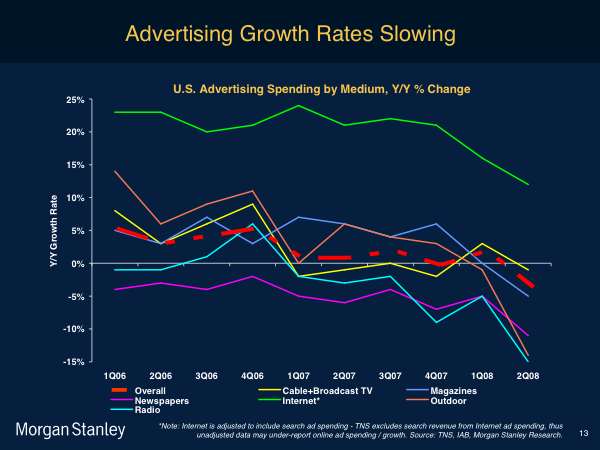
A few slides in particular stuck out for me. First, the growth rates for both e-commerce sales and Internet advertising are normalizing much faster than anyone expected they would compared to offline growth rates for retail sales and advertising. No doubt, this steep slowdown in growth is being compounded by the overall economic situation. ...

In the second slide, the top green line is Internet advertising growth. At least it is still above all the other kinds of advertising and not yet in negative territory, but the trend does not look good.

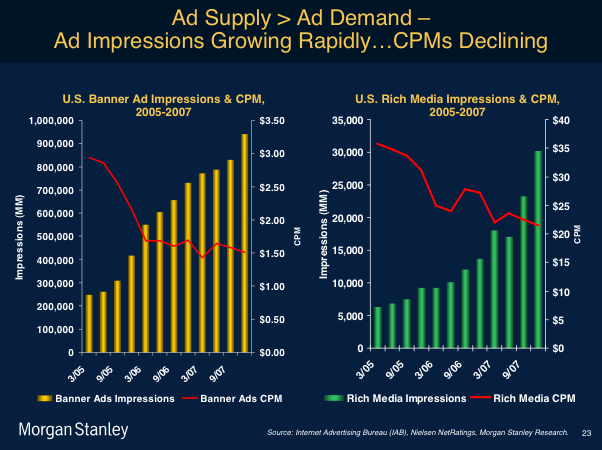
In fact, as ad budgets decline and Web pages keep growing, the bigger problem is that the supply of ad slots on the Web is becoming greater than the demand to fill them. The only way to fill those slots is to lower the price of each spot. As the slide below illustrates, ad impressions keep growing, but the cost per thousand (CPM) keeps dropping (on average, to about $1.50 for banner ads and to just above $20 for rich media ads):

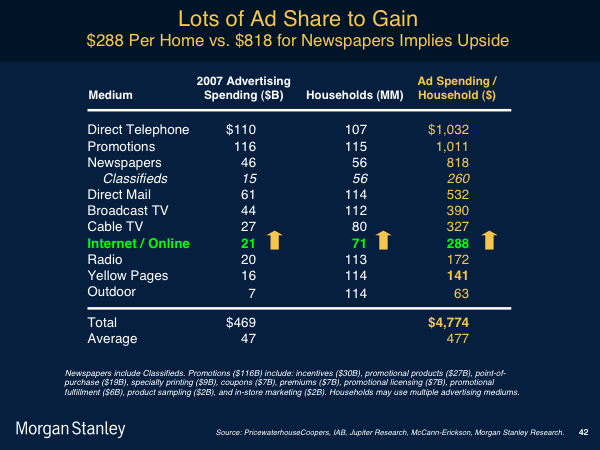
On the bright side, compared to the overall spending on other forms of advertising such as TV, print, and direct mail, Internet advertising still has a lot of share to gain, and will likely continue to do so.

Mary Meeker Web 2.0 Presentation
View SlideShare presentation or Upload your own. (tags: advertising web)

Nov 3, 2008

Exitmercials Push Visitors to Advertiser Websites

Ad buyers jump through too many hoops for low ROI
Online advertising creates friction for the ad buyer. 
Why do buyers jump through so many hoops to entice visitors to their website?
tEarn exitmercials solve the problem.

History of Advertising

Whether newspapers, magazines, coupon mailers, yellow pages, or TV broadcasts - an advertiser bundles their advertising with other content. Delivered as a media product, the advertiser is promised:
  • A minimum circulation.
  • Savings when compared to mailings.
Buyers pay a cost per thousand (CPM) like $50. When compared to minimum direct mail costs of $1.00 each, participating at $50 CPM is much cheaper than $1,000 CPM. Conversely, the $50 CPM has a cost per impression of a nickel, substantially cheaper than $1.00.

A magazine or Yellow Page book with 50,000 circulation would charge $2,500 per page - less for partial pages. This compares to $50,000 for a direct mail campaign via the USPS. 

That's the core economics of advertising.

Banners, Spots, Skyscrapers, and Other Display Ads

In 1993, I participated in the early phases to standardize online advertising. Cnet proposed banners. We pushed spots. ZDnet invented skyscrapers, initially to fill the extra space on the right edge of wide-screen monitors. 

Standards emulate print advertising.
  • Advertisers supplied a creative image in standard sizes.
  • Rather than show the same banner to every visitor, the practice randomizes - thus showing different ads to visitors. This made it hard for the buyer to find their own ad, since it may not show during their visit. 
  • The ad server controlled delivery, to provide the buyer with the exact number of deliveries that they contracted for. The buyer can buy any quantity - not just the fixed circulation of the publisher. 
  • Creative talents worked in the limited space to entice viewers to click and learn more.
  • A click takes visitors from the ad to the advertiser's web site. This is a click through.
This high friction process has become a multi-billion business with billions of ad deliveries, but low click-through rates. 

Ultramercials (i.e. fancy interactive banners), in-game, in-video, and in-text advertising continue the tradition of ads embedded on a page. Each is a high-friction buy with typical single-digit or less click-through rates.

Enter Google Text Ads

Google created Adwords. Yahoo, Microsoft, and others copied the model.
  • Buyers supply two phrases of limited length. One is the headline. The other is a tagline. 
  • Copy writers struggle with catchy phrases to attract buyers.
  • Buyers choose keywords that match customer interests to the advertiser's products. 
  • With the complexity of synonyms, buyers often choose thousands of keywords to describe their offering.
  • Buyers bid to pay a cost per click (CPC) or cost per action (CPA). When readers click on the ad, they are directed to  the advertiser webpage. Buyers pay only when clicked - a paid click.
  • A robot controls placement of ads on a page and the order of ads in a column. Buyers don't control placement and frequency - creating frustration.
Despite this high-friction process, CPC has also become a multi-billion business. CPC solved the low click-through rates of display ads. Buyers pay when there is a click-through - a paid click.

As stated by the Google CFO in 2008 Q3:
"there is insatible demand for any paid click we produce."
  • Efficient Frontier reports that CPC buyers pay from $0.30 to $0.60 per click. 
  • Google has reported mortgage brokers who pay over $4.00 per click.
When compared to $50 CPM display ads:
  • If 10% of viewers click-through, the equivalent CPC would be $0.50. 
  • At average click-through rates of 1%, the equivalent CPC is $5.00. 
  • At lower click-throughs, the CPC would be higher.
Average CPM rates have dropped. 

CPC has won increasing share of online ads. 

Buyers want click-throughs.

tEarn Exitmercials Push to Advertiser Websites

tEarn's patent-pending exitmercial system pushes qualified visitors to advertiser websites. 
  • Buyers supply a website or webpage.
  • Buyers choose a target audience.
  • Buyers choose a CPC or CPA.
Exitmericials push relevant visitors - a paid push - 100% ROI by definition.

There is no friction from:
The paid push results in a website visit without friction. Buyers focus on their product, image, and website to retain customers. 


Conclusion

Innovation simplifies.

Buyers want hits on their website. 

tEarn pushes without friction. 

How many pushes do you need?


Support Our Sponsors: