- Banners did not serve advertisers well. It's time to abandon them.
- Rich interaction is the future of online advertising - joint standardization allows users to acclimate to change with the least noise.
- Publishers cannot lay back and let Google commoditize online ads. The millions spent by Google to integrate CPM banners into AdWord is now wasted.
- Fixed, XXL, Pushdown - what a horrible set of names from a group that should understand branding. Gag. What can we expect from a committee of dinosaurs.
Mar 10, 2009
27 Huge Publishers Join To Replace The Banner
Jan 28, 2009
CLIP Yahoo CEO Bartz: “This Is Not A Company That Needs To Be Pulled Apart For The Chickens.”
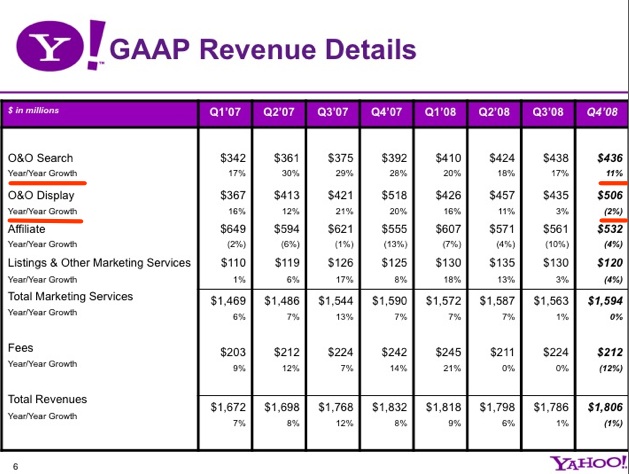
Yahoo released its fourth quarter 2008 earnings today. Its non-GAAP EPS came in at $0.17 a share, above the $0.13 consensus. (Yahoo lost $0.22 a share on a GAAP basis due to restructuring and impairment charges). Total revenues came in at $1.8 billion, with net revenues (after what Yahoo pays to network partners) coming in at $1.375 billion.
Overall revenues were down one percent. In comparison, Google’s fourth quarter revenues were up 18 percent. Search revenues on Yahoo’s own sites were up 11 percent in the quarter to $436 million, while display advertising revenues was down 2 percent to $506 million. (See chart below). That is pretty much in line with industry trends. Affiliate, listings, and other marketing revenues were also down.
New CEO Carol Bartz finally addressed some questions on everyone’s mind. Addressing Wall Street analysts on the call, she said preemptively before taking questions:
Did I come to Yahoo to sell the company? No. . . . Am I planning on immediately selling the search business? I did not come here with preconceived notions. It is very easy from the outside to have preconceived notions of what Yahoo should do. Now as an insider and CEO it is my job and responsibility to do what is best for customers, shareholders, and employees.
Later on in the call she reiterated:
This is not a company that needs to be pulled apart for the chickens.
Asked about rumors that Yahoo has been meeting with Microsoft, she replied:
We don’t have comments on press reports that come from nowhere.
That would be a reference to Valleywag.
She is basically signaling to investors that they should let her do her job. Her general message on the call is that outsiders cannot really know what is the best course of action for Yahoo. Fair enough. She has only been on the job for eight days. But she also isn’t communicating where she wants to take the company. What’s the plan, Carol?

Crunch Network: CrunchBoard because it’s time for you to find a new Job2.0
Nov 21, 2008
New York Times (NYT) Now Losing Business To Wall Street Journal
Ed: eCPM is just shy of $200.
from Silicon Alley Insider by Eric Krangel
As if the New York Times wasn't having enough trouble keeping up with an ad recession and the Internet crushing its print business. Now the newspaper is facing increasing competition for printads... from Murdoch's Wall Street Journal.
Bloomberg: Saks Inc., a Times advertiser since 1924, recently chose to promote a new Chanel boutique and made-to-measure men's suits in the Journal. Owner Rupert Murdoch's expansion of general news coverage and a new lifestyle magazine are starting to attract wealthy consumers and create ad space for retailers, said Milton Pedraza, chief executive officer of Luxury Institute LLC.
``They certainly have become a significant part of the advertising mix for luxury brands where they were not before,'' said Pedraza, whose New York research group tracks the market for the most expensive lines of consumer goods and services. ``They're definitely stealing advertising dollars.''
And then there's the stats: The WSJ has a paid circulation of 1.4 million, up 2.4% y/y. The NYT: 859,000, down 5.5%. With more readers, the WSJ can charge more for ads, $264,426 for full page color vs. $193,800 at the NYT.
Nov 7, 2008
Mary Meeker’s View Of The World In 50 Slides
Ed: Good analysis, but simplistic and superficial with respect to online advertising. As an econometrician of world markets, it's always been difficult to simplify multivariate, multi-equation, dynamic models so that Wall Street pundits depend on stochastic input-output models. Wall Street looks at historic results. Analysts poorly model the process of cause, effect, stimulus, and temporal impacts.
- Another chicken-little forecast of the economy that ignores the "one time in history" economic stimulus from rapid price deflation. Is 2000 relevant? Did Morgan Stanley even identify the current spike event as relevant?
- Advertising total demand grows slower than total supply - leading to price declines. This assumes commodization of ad inventory. As long as publishers act like lemmings and blindly follow current practices, the result would be commodization and falling prices. How can publishers avoid commodization? Will exitmercials change the economics of advertising?
- Why is Google growing? Why are display CPM's declining? What do advertisers really want?
Every year at the Web 2.0 Summit, Morgan Stanley Internet analyst Mary Meeker gives her view of the world, the Web, and the technology industry by quickly going through about 50 slides that illustrate the major trends she is tracking. Last year, she zeroed in on the China Bubble. This year, she talks about the root causes of the current economic downturn, the outlook for Web businesses, and where she still sees major growth (mobile and emerging markets).
She singles out the mobile industry as the one where both the most opportunity will be found and disruption will occur over the next five years. Moreover, she suggests that the U.S. is poised to lead the transition in mobile to a Web-centric model. (I totally agree). Interestingly, she points to the introduction of the first Android phone by T-Mobile, not the launch of the iPhone, as the key inflection point for the coming era of the mobile web.
Meeker’s full presentation, which she gave yesterday, is in the video embedded above and her full slide deck is below (thank you, Henry Blodget, for uploading them). The slides are also available here.
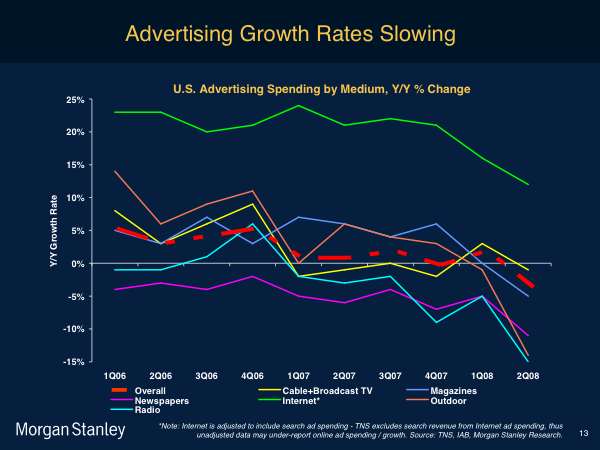
A few slides in particular stuck out for me. First, the growth rates for both e-commerce sales and Internet advertising are normalizing much faster than anyone expected they would compared to offline growth rates for retail sales and advertising. No doubt, this steep slowdown in growth is being compounded by the overall economic situation. ...
In the second slide, the top green line is Internet advertising growth. At least it is still above all the other kinds of advertising and not yet in negative territory, but the trend does not look good.
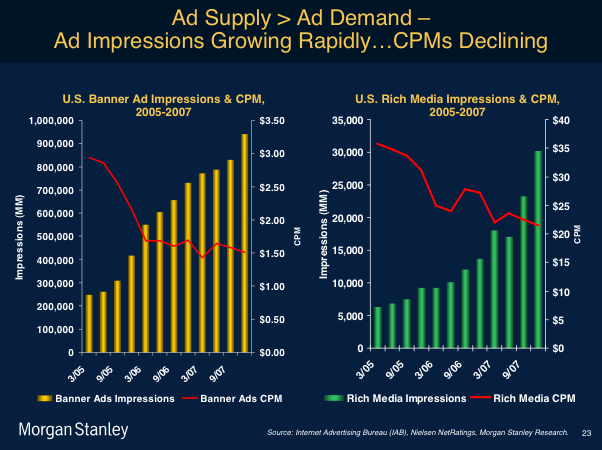
In fact, as ad budgets decline and Web pages keep growing, the bigger problem is that the supply of ad slots on the Web is becoming greater than the demand to fill them. The only way to fill those slots is to lower the price of each spot. As the slide below illustrates, ad impressions keep growing, but the cost per thousand (CPM) keeps dropping (on average, to about $1.50 for banner ads and to just above $20 for rich media ads):
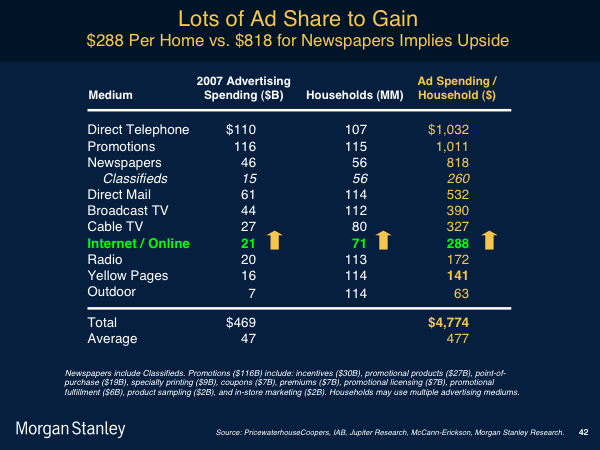
On the bright side, compared to the overall spending on other forms of advertising such as TV, print, and direct mail, Internet advertising still has a lot of share to gain, and will likely continue to do so.
Nov 5, 2008
Whither the Click? Why Bother with the Click?
Ed: Let's simplify.
- Click rates less than 0.1%
- Advertisers want visits at their website
- Push targeted visitors with tEarn exitmercials.
Whither the Click?
By Gian FulgoniImpact of Online Display Advertising Absent the Click
Part I: Its Impact on Site VisitationLast month, the IAB invited me to present a summary of comScore's Q2 2008 e-commerce trends as part of an IAB webinar where the IAB released their Q2 online ad spending data.
The IAB data were assembled and presented by Price Waterhouse Coopers (PWC) and were most interesting. Overall, the data were reassuring, with a growth in online ad spending of 13% versus year ago. Search continued to grow strongly (+24% vs. YA) while display ads (i.e. banners) grew by 8%. Consistent with the PWC data, CMR also reported an 8% increase for display ads. Let’s hope we see more of the same in Q3 and Q4!
At about the same time, Nielsen released its own estimate of display ad spending for the first half of 2008 and reported a 6% decline. I was intrigued as to why the Nielsen number differed so widely from the PWC and CMR estimates and spent a little time digging into the numbers. It turns out that Nielsen reports online ad spending for CPM-based display ads, while the PWC and CMR numbers include both CPM and “pay-for-performance” display ads (i.e. CPM, CPC and CPA deals).
So, in interpreting the data, it would appear that advertisers are shifting large amounts of their display ad spending from CPM to CPC / CPA deals. With today’s tough economy, I don’t think this is surprising – since it’s natural for advertisers to demand more performance. But, I think there’s more to the story. In a study comScore completed earlier this year with Starcom and Tacoda, we measured click rates across all online display campaigns in a month and found them to average less than 0.1%. Does this mean that display ads aren’t having any impact? I don’t think so. I think the issue is that a click no longer reflects the effectiveness of a display ad. Just as we wouldn’t expect that print ads, TV ads and radio ads should generate immediate consumer response, why would we expect it to be so with online display ads?
We've conducted extensive research at comScore that confirms the impact of display ads. Using our behavioral panel, our analysis compared the behavior of consumers who were exposed to display ad campaigns with a control group who were not exposed. The control group was carefully selected to be demographically and behaviorally balanced with respect to the exposed group. Below, I’ve shown the average impact of 139 display ad campaigns in terms of their ability to drive visitation to the advertisers’ sites:
The impact of the display ad campaigns is clear, with substantial lift in site visitation occurring in the first week of exposure to the campaign (+65%) and continuing through the fourth week following initial exposure (cume +46%).
So, with these types of positive results, are we to conclude that advertisers who pay on the basis of CPC arrangements are making a mistake? I think the answer is “yes and no.” “Yes,” because it’s clear that a singular focus on display clicks is misleading and does not reflect the actual impact of the ad campaign. "No," because smart advertisers understand the benefit of running display campaigns and that paying based on the number of clicks realized is economically very attractive. They get the “view through” impact of the ads but only pay for the small number of clicks that are generated. That’s a great deal for the advertiser -- but a poor one for the publisher. I think it behooves publishers to consistently measure “view through” impacts and to use the results to charge a fair price for the holistic performance of display campaigns that are run on their properties.
In my next blog posting I’ll reveal further evidence of the effectiveness of display advertising by focusing on its impact on consumers’ search queries.
Nov 4, 2008
Ad-Supported Services at Gnip, Brightcove Shutting Down - Low eCPM
XMPP/Jabber, the Open Source real-time communication protocol popularized by Instant Messaging that many have hoped would serve as foundation for a real-time web of the future, has become too much trouble to support and will no longer be a supported protocol at Gnip. More than just one protocol, it's a story of long tail developer communities and the ambitious startups forced to make resource decisions. Gnip founder Eric Marcoullier told us that the company really wants to support XMPP but that it's taking up an inordinate amount of support time, in many cases just because data consumers are using Google Talk or Jabber.org servers and are being throttled... Not Enough Revenue According to a blog post by Adam Berrey, Brightcove's Senior VP of Marketing and Strategy, the advertising financed Brightcove Network only drove about 1% of Brightcove's revenue, so from a purely financial perspective, it must have been an easy decision for Brightcove to shutter the free version of its service... Mobuzz, one of the more popular online shows to come out of Europe, has run out of money. But instead of bowing out, the site is turning to its users and asking for a €5 donation (or the equivalent in your local currency). The goal? 120,000 Euros by next week, which Mobuzz says should be enough to sustain the site until it can get more funding. If it doesn’t make the cut, the site will be shut down and any donations will be returned...Gnip Says XMPP Ecosytem Too Half-Baked, Pulls the Plug
There's no more riding through the transit station on roller blades - the rental shops aren't keeping them in good enough repair. That could be an analogy for a decision announced today by Gnip, a startup aiming to become the ultimate ping server for social media.Video Site Brightcove Shuts Down Free Services
Brightcove was once considered to be a formidable challenger for YouTube. However, just about a year ago, it became clear that the company had given up on this dream when it announced that it would no longer accept direct consumer uploads to its service. Since then, Brightcove only featured content from its roughly 40,000 publishing partners on the Brightcove Network, though its main business has been its white-label video platform. Today, Brightcove announced that it will also close the free Brightcove Network and completely focus on its premium services.Strapped For Cash, Web TV Startup Mobuzz Starts Panhandling

Oct 24, 2008
Online Text Ads Most Clicked, Why Bother with CPC?
Online Text Ads Most Clicked, Only Young Like Video
Despite current buzz around fancy and expensive video ads, only 11% of consumers say they are likely to click on them, compared with 25% who would likely click on simple text ads and 20% who would click on right banners, according to a study from iPerceptions, Inc.
Though video ads are unpopular overall, the under-25 set is more likely to click on them than on any other type of ad. This age group accounts for nearly one-third of the video-ad viewing audience.
First-time visitors to a site and those with lower incomes also are more likely to click on video ads than other ad types.
The study found a strong relationship between income and likelihood of clicking. As consumers’ incomes rise, they become less likely to click on ads. On average, 40% of consumers likely to click on any ad make less than $50K a year - and only 15% make more than $150K. The income gap is most pronounced with video ads, with 49% of consumers likely to click on video ads making less than $50K a year - and only 13% making over $150K.
Click frequency also increases as site loyalty rises. Across the board, 65% of consumers likely to click on online ads are weekly or daily browsers on a site, and only 15% are first-time visitors and 6% are sporadic visitors...
Oct 16, 2008
STATS: CPC up, CPM down
Ed: Compete.com reports 35.7% YOY growth in number of USA search. Google CFO reports paid click growth of 18%. CTR declined by 13%. Fewer % of people clicked on ads.
All Eyes On Google This Week
Display Ad Prices Trending Downward; Fall-Off Is Consistent, But Not 'Dramatic'—Pubmatic
Google, whose stock is down 45% this year, announces third quarter financial results tomorrow, and Silicon Valley will be watching. Analysts expect revenues of a little over $4 billion and EPS of $4.79 - and most have price targets for the stock, which closed yesterday at $363, to bounce back up to the high 500’s.
For now, the big factors affecting Google are the strengthening dollar (half their revenue is outside the U.S.) and general pessimism about the advertising market moving forward. There are also concerns about the intense regulatory scrutiny of the Google/Yahoo search deal.
Beyond this quarter, though, no one really has any idea how Google will do, and that uncertainty is what’s driving Google’s stock down. A declining stock market means less consumer spending, which then means less advertising dollars flowing as well. But what isn’t certain is how that will impact Internet advertising, which is still taking share from more traditional ad spending.
Citi analyst Mark Mahaney, who’s targeting Google stock at $590, thinks Google is in a good position to weather a storm: “GOOG is the market share leader – and is gaining share – in arguably the most dynamic part of Internet advertising – search, which appears to be less impacted by the current macro economic environment,” he said in a recent preview report for the fiscal quarter. He also sees strong growth potential for non-search ads through YouTube and DoubleClick. ComScore is reporting that the growth in the number of searches on Google accelerated in September.
Here's some more evidence of how bad things are… The average price of a display ad was 27 cents in Q3, a nearly 50 percent drop from Q407's 50 cents, according to Pubmatic, which sells software optimization tools to ad networks and has been surveying prices for the past four months. In Q1, the company said the average price of a display ad was 37 cents, while from Q2's price was 34 cents, said Pubmatic, which bases itsPubMatic AdPrice Index (PDF) on a survey of roughly 5,000 websites mostly in the U.S.Google CFO:
We had another solid q, despite a challenging economic environmentgross revenue up 31 % yoy to $5.5B
Google.com was up 34% yoy to $2.7B
AdSense up 15% yoy to $1.7Bpaid click growth up 18% yoy, up 4% q over q
US revenues up 22% yoy to $2.7B, up 5% q over qInternational revenue:
UK showed some softness, essentially flat Q over Q,
rest of EMEA performed better, relatively good performance in Netherlands and Germany,.
Also good performance in Brazil and China.
Why Google’s Partners Should Be Worried
Google today announced its third-quarter 2008 earnings — which were in line with investor expectations, thus giving market a reason to exhale. For the quarter, Google reported net income of $1.35 billion on sales of $5.54 billion.
Google’s partners however, should gulp hard, for the Mountain View, Calif.-based search and online advertising company is keeping more and more of its online ad bounty for itself. You can see that from the three metrics: revenues from Google-owned sites, revenue generated by partner sites and the traffic acquisition costs. Google’s partners’ piece of the pie isn’t growing that much. Check out the table:
Q3 2008 Q2 2008 Q3 2007 Google-owned site Revenues $3.67 billion (67% of total revenues) $3.53 billion (66% of total revenues) $2.73 billion (65% of total revenues) Revenues from Partners $1.68 billion(30% of total revenues) $1.66 billion (31% of total revenues) $1.45 billion (34% of total revenues) TAC $1.5 billion (28% of total revenues) $1.47 billion (28% of total revenues) $1.22 billion (29% of total revenues) What that table is saying is that Google today is less reliant on partners for ad inventory. This shift isn’t going to change anytime soon, especially as Google launches more and more ad-supported services and finds new users for Google Mail and Google Android.
Google Gains 2 Points of Search Share in Q3, CPCs rise on Google Search and Content
Today we released the Efficient Frontier Q3 2008 U.S. Search Engine Performance Report. which analyzes the performance of Google, Yahoo, and Microsoft Live Search on search engine spending, CTR, CPC and ROI from advertisers in the Efficient Frontier Client Index. Because conditions in the finance sector have been so volatile over the past year, trends were reported separately for financial services advertisers and non-financial services advertisers.
Google continued to gain share for all advertisers over last year, capturing 76% the share of total search engine spending in Q3, up 2.1 percentage points from Q3 2007. That gain in share was largely due to growth in Google content spending, which increased from 2.6% to 4.6% of spending from Q3 2007 to Q3 2008. Content spending increased by 82.8% YOY in Q3 2008 for non-financial services advertisers, and by 16.6% in financial services.
A look at trends in CPCs across search and content gives an indication of why advertisers are investing more in Google content and continue to spend on Yahoo and Microsoft Live Search. On a YOY basis CPCs on Google search increased by 8.3% and 4.7% respectively for financial and non-financial services advertisers. CPCs declined YOY for Microsoft Live Search and Yahoo Search, with the exception of CPCs on Microsoft Live Search for non-financial services advertisers, which were up 6%. Google content CPCs increased by 20% for non-financial services advertisers, but at $0.28 a click, Google content is still 53% cheaper than Google search, which averaged $0.61 per click in Q3.
The report also found that, in an increasingly unstable economic environment, ROI improved on all three major search engines in Q3 2008 on a YOY basis. Google search ROI for non-financial services advertisers increased by 11.3%, Yahoo search by 19.7% and Microsoft Live Search by 29.9% YOY.
For more findings from the report, read our press release, or download the full report here.
Oct 15, 2008
Nielsen/Norman Group Says Banners Don't Work
What If You Ran an Ad, and Nobody Saw It?
Jakob Nielsen knows web users. The Nielsen/Norman Group, which he co-founded, has tested thousands of sites. It’s watched more than 3,000 users try to perform tasks online, even following their eyes to see where they look. And he has some frightening news:
Nobody looks at picture advertising.
Nielsen, in a keynote address at the inaugural Web Experience Forum in Boston, Mass., said web design is doomed to failure unless we learn from end users. And one major lesson is that other than paid search, ads don’t work.
“We call this banner blindness — people won’t see ads at all,” said Nielsen. “Ads might as well not exist as far as users are concerned, except for search ads.” The number of web users that so much as glance at banner ads, he added, is too small to even quantify.
The findings are no secret to web usability professionals gathered here, who obsess over how consumers use the web. But they’re often ignored by ad buyers.
“For the longest time, the web has been in collective denial of this phenomenon,” said Nielsen. “People still have this old media thinking: They think of the web being similar to TV because it’s on the screen and visual. The main distinction is whether it’s active or passive, not whether it’s on a screen or not.”
Advertising revenues, which pay for much of the web, are having a rough year, with some analysts cutting their estimates for the entire sector.
Nielsen pointed out that paid search still works — partly because it’s relevant, and partly because users aren’t tuning ads out. “We thought we’d find [paid search] box blindness the way we did banner blindness, but that’s not the case. Users are interested in search ads and actually look at them.”
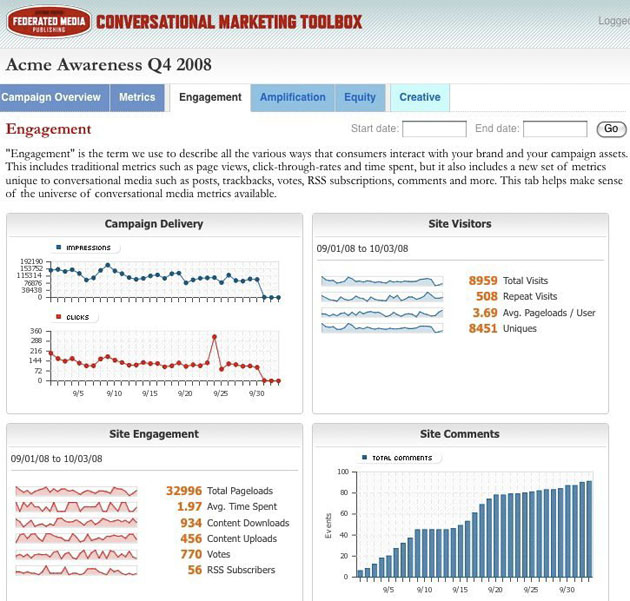
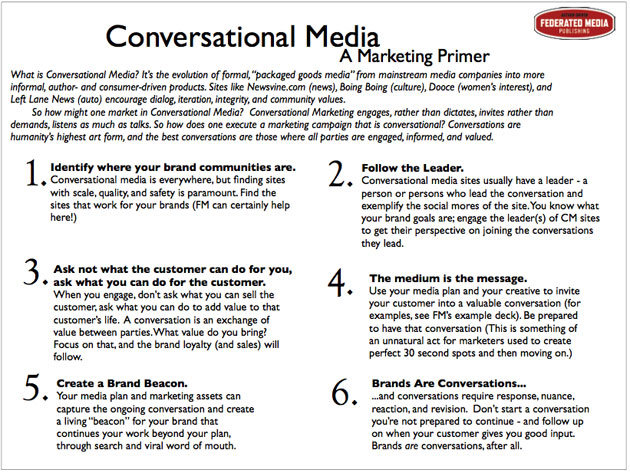
Federated Media (our advertising partner) has been experimenting with “conversational marketing” almost since their launch in 2005. Today they are launching a new marketing toolbox for advertisers which gives them tools to track all the ways users interact with these ads. The goal, says Federated Media, isn’t just to track ad impressions and clicks, but also to look at a new set of metrics like posts, trackbacks, votes, RSS subscriptions, comments, etc, where users somehow interact with the advertisement and talk about it. Hopefully, a conversation occurs between users, the ad publisher and the advertiser, which gives the advertiser’s brand more face time. An old example of this is Hakia’s ad that asks bloggers what better search means. Other examples are here. The definition of conversational marketing is a little squishy. But the general idea, which Federated Media founder John Battelle writes about in the primer below, is that you as an advertiser figure out which content sites best associate with your brand, and then you grab the leader in that space and pay them to start conversations on your behalf: Early efforts didn’t pan out so well as authors were accused of conflicts of interest - users didn’t know where editorial stopped and advertorial began. It’s not clear those issues have been resolved, but Federated Media says a proper disclosure policy is the right place to start. Convinced? It’s certainly controversial, but brands love it because they get a higher return on their advertising investment. That means it’s here to stay.Federated Media Unleashes The Conversation As An Ad


Popular Posts - Tag and Earn More
- Apple on a Roll
- Understanding Facebook for Web 1.0 Users
- eBook, Self-Publishing, Starving Writers Gain Ad-Supported ePublishing
- New Media: The Problem is Monetization, The Solution is $50.00+ eCPM
- Profiling the Internet and Online Advertising
- Contextual, Behavioral, and AI Targeting
- Internet Consolidation or Fragmentation
- New Internet Roles with Social Media
- Blogging Ecosystem of Distribution Gadgets
- SEO or 'Flypaper Effect'
- Reality Television Comes to Journalism - Thy Name is Blogger
- Feeds, Weeds, Reads, and User Needs
- Sex, Money, Power - The Anchor of Social Media
- Forum: Anyone able to earn $100+ eCPM
- Lead Generation, Direct Mail, eMail, Word-of-Mouth, Buzz Marketing, Social Media Compared


Google, whose stock is down 45% this year, announces third quarter financial results tomorrow, and Silicon Valley will be watching. Analysts expect revenues of a little over $4 billion and EPS of $4.79 - and most have price targets for the stock, which closed yesterday at $363, to bounce back up to the high 500’s.