SES returns to the San Jose Convention Center August 18-22, 2008 SES San Jose affords delegates the largest learning and networking opportunity of the year, as the 70+ sessions (80% of the sessions are new to the agenda) will cover everything that is search related and the numerous networking parties are back, including the famed Google Dance and Search Bash. Fellow marketers, webmasters, executive decision makers, including first timers and SES Alumni, will converge to learn how to maximize their business's Search Engine Marketing (SEM) opportunities, including Search Engine Optimization (SEO) and Paid Search advertising, in addition to staying informed of the latest industry, tools, and algorithm developments and solutions. This is the one event of the year you do not want to miss.
Join us for our 10th Annual SES event this August in San Jose, California, home to the largest concentration of successful internet and high-tech companies in the world.When You Register: Win a Mazda3!* 


Lee
Siegel 
Satya
Nadella 
Chip
Heath 
Jim
Sterne 
Matt
Cutts 
Kirsten
Mangers
Jul 15, 2008
SES returns to the San Jose Convention Center August 18-22, 2008


Jul 8, 2008
NEWS: Jarvis: The end of SEO?
Jarvis: The end of SEO?
As Google gets better at providing more personalized results, the importance of Search Engine Optimization seems to decline, according to new media guru Jeff Jarvis.
SEO and Googlejuice (how far a website ranks in the search) might have been as important as a company's EBITDA (Earnings Before Interest, Taxes, Depreciation and Amortization) in the past, but that may not be the case today.
"What does that mean to brands? The world gets confusing once more. But I think it means that true relevance becomes more important than SEO tricks," said Jarvis.
The relationships between brands and people may become more important than spending resources on optimizing the rankings of news stories.
"It also means that the more relationships you have with people -- the more they talk about you and link to you and click on you -- the better off you will be," Jarvis said.
The end of SEO?
from BuzzMachine by Jeff JarvisGoogle is trying to get better and better at anticipating what we’re looking for whenever we search; that’s what Marissa Mayer has said. They have been making better use of geography, not just sensing our country and language but now asking us to say where we are so it can give us local results. Since last year, it has been using our search history, if we allow, to improve our searches. The universal search tries to freshen up results with news, multimedia, and more, and I sense that the algorithm is giving more weight to currency...
Apr 24, 2008
Comscore: Actually, We Were Right. And Google's US Business Stinks
The bottom line? Dr. Magid Abraham, Comscore CEO: When Google announced strong Q1 earnings last week, some financial and media analysts wrote thatcomScore’s reports of slowing growth in Google’s paid clicks missed the mark. That conclusion is patently false. Unfortunately, many pundits attempted to draw conclusions about Google’s worldwiderevenue performance based on comScore’s domestic paid click data, resulting in an apples-to-oranges comparison. Had they used comScore's domestic paid click data to better understand Google's domestic revenue trends, they wouldn't have missed an important U.S. story and they also likely would have avoided making the wrong call onGoogle’s worldwide business. Following several historical quarters of strong sequential domestic revenue growth (including the seasonally equivalent Q1 2007), Google’s Q1 2008 revenue growth was essentially flat, which represented a significant change for Google’s domestic business. Such an important trend was also evident in comScore’s paid click data. The chart below shows the directional association between comScore’s domestic paid click trends, as compared to Google’s domestic revenue trends. [The chart can also be viewed at the following link:http://www.comscore.com/images/google_us.gif] President and CEO comScore, Inc.Comscore: Actually, We Were Right. And Google's US Business Stinks


Of course, this is not a perfect correlation because the comScore data do not include the impact of changes in Google’s price per click and do not include paid clicks from partner sites like AOL, Ask, Washington Post, etc. nor paid clicks from the AdSense network. But the strong relationship of the two trends is undeniable.
There is of course a lesson to be learned here. To extrapolate a single data point across all aspects of a company's business can lead to wildly inaccurate conclusions.
Finally, to confirm the accuracy of the comScore paid click data, we previously published an apples-to-apples reconciliation on this blog. This analysis reconciles thecomScore data with metrics shown in Google’s Q1, 2008 financial report. In short,comScore got it right – both quantitatively and qualitatively. What was wrong were the conclusions that some people drew based on inherently flawed comparisons.
Dr. Magid Abraham
Apr 23, 2008
Driving Site Traffic With Search Engine Optimization and Paid Advertising
SEARCH ENGINE OPTIMIZATION (SEO)
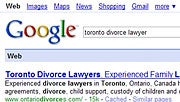
SEO refers to modifying your Web pages to enhance your visibility in search engine results. If your business sells, say, left-handed widgets, your goal is to be listed near the top of the results if someone performs a search using the keywords "left-handed widgets." Research shows that if your site isn't within the top 30 search results, very few visitors will click through to your site.
How do you reach that coveted high rank in a search engine? You have to learn to think like the robots (also called spiders and crawlers) that search engines such asGoogle use to find and catalog Web pages. First, learn to describe your products and services at your Web site using words that your prospective customers would likely use in a search (most search engines understand words, not images).
SEARCH ENGINE ADVERTISING
If you don't like waiting months for SEO benefits to kick in, I recommend advertising on search engines for fast results. The paid approach might bring increased traffic to your site within as little as 24 hours.
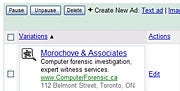
The most popular type of search engine advertising--and the easiest to set up--is the pay-per-click (PPC) text ad. You write short text ads that display next to the search results for specific terms or keywords that people enter in a search engine. You pay for each visitor who clicks on your ad and is then directed to your Web site...
The cost spans a wide range, from a few cents to several dollars per click, depending on how much a certain keyword is in demand among advertisers. You can set a daily or monthly maximum charge to ensure that you don't outspend your budget.
Apr 17, 2008
Google paid click growth slowing - Advertising Shelf Space
- Nov 2007, Google stopped using the text box as the click area. Net effect is huge drop in shelf space and more than 25% loss of clicks.
- Google continues to use the text box as the click area on affiliate search pages.
- Yahoo still uses the full box for top of page SEM ads.
- Yahoo extends the click area to the entire title area for skyscrapers.
- CPC click rates and CPM click-through-rates may be statistically un-differentiated when adjusted for square inch of clickable area.

Study: Google Lost Share of Search Ad Dollars to Yahoo
If the results of a study by SearchIgnite, a search advertising technology firm, prove representative of the broader search market, something unusual happened in search ads in the first quarter: Google lost share to Yahoo in the United States.
The report shows that spending by search advertisers on Yahoo grew a robust 57 percent while spending on Google grew only at about half that rate. That meant Google’s total share of search ad dollars declined slightly to 70.4 percent, while Yahoo’s rose to 24.2 percent. Microsoft’s declined slightly to 5.4 percent.
“It was unusual and unexpected,” said Roger Barnette, president of SearchIgnite...
From Silicon Alley Insider: On the face of it this looks like bad news in stark contrast to the good news on 38% UK internet ad spend growth in 2007, but for a couple of reasons it isn’t as bad as it first seems. The ‘this isn’t so bad after all’ argument notes that the number of searches continues to increase (33% year-on-year to March) and says the decline in clicks is due to Google’s ongoing efforts to improve lead quality for advertisers and the experience for searchers, which has resulted in a much lower search to paid click conversion rate. If this is right the quality of the clicks and hence the revenue per click will have increased - and Googles revenues will still be growing much faster than 2%. Analysts’ consensus is for 25% revenue growth. Results are out on Thursday, which will be interesting. If this is true we should all be seeing our cost per click increase on adwords, but that will be offset by improved conversion rates. I will start asking my portfolio if that is the case. I buy the argument that the growth in paid clicks is slowing because Google is trying to increase quality, but I don’t think that development will be totally offset by an increase in the cost per click. Rather, I think that up to now there has been a lot of rather pointless adwords activity which delivered little value to either advertiser or consumer, and that what we are seeing now is that activity tailing off. Partly down to Google, but also partly down to people getting smarter about how they use Adwords, particularly in the face of a recession. Either way I hope Google’s results match up to analysts expectations. Otherwise I fear confidence in the internet sector will be badly hit, which is the last thing any of us needs.Google paid click growth slowing
Google’s (GOOG) US paid-click growth in March was as bad as in
February–up only 2.7%–rounding out a violent deceleration in Q1, says
Comscore (per Mark Mahaney at Citi). In all of Q1, Google’s US paid
clicks rose only 2% year-over-year versus 25% in Q4 and 48% in Q3.
Apr 16, 2008
NEWS: Why Don't Big Brands Have Good Search Engine Optimization?
The SEM Insights blog discusses four reasons why big brands don't have good SEO. They are: Requirement: ease of maintenance: Therefore, they may not be using CMSes that are SEO friendly. Requirement: personalization and tracking: They need quantifiable results, but they don't understand that search results are going to display the most applicable page to a search query and that that every related page probably won't rank in the top 10 for a search. Requirement: language: Big brands often serve content to different countries under a single TLD. The problem is that when people in different companies search for in-country results, they won't locate the big brand. Corporate policy and legal issues: The last thing is that it takes forever in big brands to get things done. To put it simply, there's way too much bureaucracy in the corporate world. At Sphinn, the discussion continues. Forum members believe that sometimes they'll take the easy sale (an ad representative with a solid presentation) and ignore SEO (especially since they have the money to afford PPC). Another thought is that they're just so used to doing what they're doing that change is difficult. Indeed, the IT department makes things difficult. Their mantra: "if it ain't broke, don't fix it." Additionally, some copywriting just sucks. Some people just won't use keyword-rich text because they want to sound more professional and that prevails over search friendliness. What big brands need is a shift in thinking. Unfortunately, they need to kick it off if they're serious about it. Ed: CMS can't keep up. SEO is waste of time. SEM does nothing for branding.
Apr 8, 2008
STATS: March Searches, Clicks, CPC, and Demand
Google Receives 67 Percent of U.S. Searches in March 2008
Search leader reaches all-time high – up 5 percent year-over-year
Ask.com up 18 percent year-over-yearNEW YORK, NY – April 7, 2008 – Hitwise, the leading online competitive intelligence service, today announced that Google accounted for 67.25 percent of all U.S. searches in the four weeks ending March 29, 2008. Yahoo! Search, MSN Search and Ask.com each received 20.29, 5.25 and 4.09 percent respectively. The remaining 46 search engines in the Hitwise Search Engine Analysis Tool accounted for 1.72 percent of U.S. searches.
Percentage of U.S. Searches Among Leading Search Engine Providers
Domain Mar.-08 Feb.-08 Mar.-07 www.google.com 67.25% 66.44% 64.13% 20.29% 20.59% 21.26% search.msn.com 6.65% 6.95% 9.01% www.ask.com 4.09% 4.16% 3.48%
Note: Data is based on four week rolling periods (ending 3/29/08, 2/23/08, 3/31/07) from the Hitwise sample of 10 million US Internet users.
* - includes executed searches on Live.com and MSN Search
Source: Hitwise Google an Increasing Source of Traffic to Key Industries
Search engines continue to be the primary way Internet users navigate to key industry categories. Comparing March 2008 to March 2007, the Travel, Entertainment, Business and Finance and Sports categories showed double digit increases in their share of traffic coming directly from search engines.
U.S. Category Upstream Traffic from Search Engines and Google - March 2008
Category Percent of Category
Traffic from Search
Engines, Mar-08Percent Change in Share
of Traffic From Search
Engines, Mar-08 - Mar-07Percent of Category
Traffic from Google,
Mar-08Percent Change in
Share of Traffic
From Google, Mar - 08
- Mar-07Health and Medical 45.10% 4% 29.80% 5% Travel 33.42% 9% 22.82% 21% Shopping & Classified 25.35% 0% 16.44% 7% News and Media 21.54% 2% 14.21% 5% Entertainment 23.99% 14% 15.26%
18% Business & Finance 18.17% 15% 11.64% 28% Sports 12.93% 14% 8.58% 21%
All figues are based on U.S. data from the Hitwise sample of 10 million Ineternet users.
Source: Hitwise
Cost-per-click data by vertical category in search in the U.S.
A look at the average cost-per-click in search by vertical in the U.S. for March 2008 compared to the prior month. Data and research are provided by Efficient Frontier. "Total finance" includes auto finance, banking, credit, financial information, insurance, lending, and mortgage. Each vertical contains data from multiple advertisers.
Average Search CPC by Category, February and March 2008 Category CPC March ($) CPC February ($) Change (%) Total finance 2.65 2.43 9 Credit 3.30 2.65 25 Mortgage 2.32 2.05 13 Auto finance 1.57 1.47 7 Insurance 8.88 7.87 13 Travel 0.76 0.72 6 Automotive 0.50 0.50 0 Retail 0.39 0.37 5 Dating 0.38 0.37 4 Source: 2008
Ed: Global search growth up 31%; 3% share growth; paid CTR decreased 25%+; CPC increased 6%; thus, paid CPC demand grew less than 25%.
... At this time last year Google was at 64% and MSN was at 9%. Momentum remains with Google, but is that momentum inevitable? Could things change? We've written about three ways that it could. Some have argued that Google's approach to search is outdated and slow to change. Apparently it's working just fine for them today, but there's a world of opportunities for other innovators to come up with a better search experience. We wrote about this situation in our recent post titled "How Vulnerable is Google in Search?" Hitwise tracks 46 other search engines as well, which added up for a combined 1.7% of searches last month. 46 alternative search engines is like a week's work for our network blog AltSearchEgines, check it out if you'd like to learn about the rest of the industry, including some that may become the challengers of the future. Yahoo! is #2 today, but is taking the lead in support for standards based microformats and semantic web indexing. Yahoo! announced that it would index semantic markup three weeks ago. Since semantic markup could enable improvements in search quality by orders of magnitude, this could be a turning point for Google and Yahoo! As we explained when that announcement was made: We'd like to get an update on the Yahoo! semantic indexing announcement, though, and presumably this is the kind of thing that Google will do soon as well. As Google grows continually stronger and more knowledgeable, the importance of the social contract between the company and its customers becomes increasingly more important. Google has not been as good as it needs to be about taking clear steps to guarantee security and prevent misuse of user data - including its own misuse of that data! We wrote in February about how Microsoft's new levels of engagement with oppenness and data portability could offer an avenue to challenge Google, but few of our readers agreed in comments. You know what they say, though - if your mouth gets washed out with soap, you may be saying something important! It may not be Microsoft that challenges Google, but it certainly seems possible that users will draw the line somewhere and look to limit Google's omniscience. Perhaps not, though. Perhaps Google's search dominance will continue to grow and grow, month over month, year over year. Someday, if you want to know about your genetic propensity for a particular disease, you'll just as the Google. If you want to know what your kids are doing at home while you're away, you'll just ask the Google. Certainly today when we want to know what's on the web, a clear majority of us just ask the Google.Google's US Search Market Dominance Hits All Time High

Innovation
Semantic Web
Today, a web service might work very hard to scour the internet to discover all the book reviews written on various sites, by friends of mine, who live in Europe. That would be so hard that no one would probably try it. The suite of technologies Yahoo! is moving to support will make such searches trivial. Once publishers start including things like hReview, FOAF and geoRSS in their content then Yahoo!, and other sites leveraging Yahoo! search results, will be able to ask easily what it is we want to do with those book reviews. Say hello to a new level of innovation.
Privacy Backlash
Mar 18, 2008
NEWS: Earning Money from Contextual Ads
March 18, 2008 Earning Money from Contextual Ads
This session looks at the way publishers can generate revenue by carrying contextual ads offered by major networks. Learn about some programs out there and tips on getting more from the ads you carry.Moderator:
* Chris Boggs, Search Engine Watch Expert and Manager, Search Engine Optimization, eMergent
Speakers:
* Bryan Vu, Manager, AdSense Online Sales and Operations, Google
* Cynthia Tillo, Product Evangelist for Advertising Services, Adobe Systems
* Jennifer Slegg, Owner, JenSense.com
* David Singh, Head of Search Practice Area, Underscore MarketingJenSense is up first.
What are the most common sites for monetization? COntent rich sites, blogs, business sites, UGC, social media sites, forums, password protected pages, and searches
How do you want to monetize? You need to balance user experience with monetization. If your goals are that you want repeat visitors, you need to make user experience the priority. If you just want to make money, your priority is monetization. It's difficult to achieve both but it can be done.
When shouldn't you monetize with contextual advertising?
If you're a business selling products, why would you entice customers to click ads rather than buy from you? Similar, business sites that sell services have the same problem.
Any sites with content that is against AdSense polices: hacking, gambling, adult, designer imitations, weapons, etc.Beyond AdSense text ads - there are more than just text ads: image ads, video ads, link ad units, CPA and referral ads, AdSense for search, and AdSense for Mobile.
Common AdSense problems and solutions:
- Section targeting - emphasize a section on your site and deemphasize navigation, for example
- Add meta tags - this can be helpful
- Proximity keywords
- Contact Google: use this as a last resort (only if you're seeing golf ads on a site about knitting, for example)Low CTR Rate - how can I ge a higher CTR rate?
- Get better positioning but consider user experience priority
- Change title colors - hyperlink blue and same as other outgoing links
- Borders vs. no borders: it actually works better sometimes.
- Image ads: especially on pages that are very text heavy.AdSense Secrets
- Enable image ads on AdSense for an image-only secondary placement. Add a second ad unit that is image only - not many text ads on the page - different visual for people on the site.
- Also helps you take advantage of CPM ads.Ensure that the ad unit with the highest CTR appears first in HTML code.
- This ad unit will generally have the highest earing ads.
- Use multiple channels to confirm highest
- Don't confuse appearing first on the page with appearing first in HTML - look at your code
- In a case study, there was a 25% earnings increaseOne ad unit a page can make more money than two or three combined
- More is not always better
- People end up clicking on the 2ndand 3rd ad units, it may mak less EPC than if they clicked on the first ad unit
- Longer pages are the exception
- Do A/B testingBe aware that your filter list will cost you revenue
- Blocking ads will result in lower paying ads appearing, it will not free up ad space for more higher paying ads to appear
- Use the filter to block ads that are competitors, are grossly mistargeted, advertising something inappropriate for audience
- Case study: publishers with 150+ sites on filter list increased earnngs by 35% when he reduced the list to 14Use your allowed sites with caution
- Will no longer show ads on cached pages
- Adding google.com and yahoo.com will not work
- IP addresses only for all cache IPs
- Only use in specific cases
Show AdSense on pages hidden behind a login: if you have a members only or premium content section, you can allow the media partner bot to view the content to display targeted ads.
- "Site Authentication"
- Fairly new featureUsing Ad links on your sites
- Navigation
- FooterCarefully selected referral ads
- Must be extremely targeted
- Don't simply select high $ CPATakeaways:
ALWAYS do A/B testing
Experiment with different placements, colors, sizes, styles
Consider impact of being too ad heavy
Look beyond traditional AdSense text ads and experiment with other formats
Ed: I'm speachless!

 "
" Facebook
 LinkedIn
 about adEcon
 MarSP
MarSP rich media
 top
top blog
blog newspaper
 social network