[ About Us | Popular | Marcom | AdNet | IChannel | Glossary ]
Showing posts with label contextual. Show all posts

Dec 19, 2008

Note: Google’s three new patents to improve targeting in social media

Ed: Another blind men with the elephant problem. Contextual or behavioral inference depends on artifical intelligence rules. Cute stories aside, these methods don't scale. 

from Lightspeed Venture Partners Blog by 

IEEE Spectrum notes three new patent applications from Google that suggest how Google hopes to improve targeting for social media advertising:

The patents—Open Profile Content Identification, Custodian Based Content Identification, and Related Entity Content Identification—and the algorithms behind them would let Google find patterns in users’ profiles, pages, and friend lists in order to better target ads to them. Ideally, they would make the users more likely to click through.

Google’s Related Entity patent, for one, involves prying information from a user’s list of friends or user groups. But Google is not alone in this field. In June the social ad firm SocialMedia Networks said it had invented an algorithm called FriendRank that also scours a user’s friendship lists for friends whose names might be dropped in a targeted ad.

The Open Profile and Custodian patents would mine data from, say, a MySpace user’s profile and the profile of the MySpace page the user is visiting. The Open Profile patent, for instance, would consider a user profile like “I really enjoy hiking, especially long hikes when you can camp out for a few days. Indoor activities don’t interest me at all, and I really don’t like boring outdoor activities like gardening.”

Using smart language-processing algorithms to detect the user’s sentiments (“enjoy” or “don’t like” near “hiking” or “gardening”) and other linguistic cues, the system would then potentially serve up active outdoor sports-related ads to this user but avoid ads about more hobbyist-oriented activities.

Google is continuing to apply the adsense paradigm of contextual targeting, but expanding the definition of “context” to include the friend networks and the declarations of interests that are common to social network profile pages. MySpace’s hypertargeting is a similar approach.

Facebook’s engagement ads are a markedly different approach, charging for actions rather than using targeting to lift CPMs within display advertising. I think engagement ads could be a very interesting approach that takes advantage of the native behavior of “user affiliation” withing social networks.

I’m indifferent to which standard wins, but I do want a standard to emerge. We need a standard in social media advertising to unlock further scalable growth in this industry.

Aug 11, 2008

Only great minds can read this - Can AI Match This?

fi yuo cna raed tihs, yuo hvae a sgtrane mnid too

Cna yuo raed tihs? Olny 55 plepoe out of 100 can.

i cdnuolt blveiee taht I cluod aulaclty uesdnatnrd waht I was rdanieg. The phaonmneal pweor of the hmuan mnid, aoccdrnig to a rscheearch at Cmabrigde Uinervtisy, it dseno't mtaetr in waht oerdr the ltteres in a wrod are, the olny iproam tnt tihng is taht the frsit and lsat ltteer be in the rghit pclae. The rset can be a taotl mses and you can sitll raed it whotuit a pboerlm. Tihs is bcuseae the huamn mnid deos not raed ervey lteter by istlef, but the wrod as a wlohe. Azanmig huh? yaeh and I awlyas tghuhot slpeling was ipmorantt! 

Jul 8, 2008

NEWS: Has Twitter just bought itself a business model?

Has Twitter just bought itself a business model?

Posted by Steve O'Hear @ 7:30 am

Has Twitter just bought itself a business model?A flurry of reports yesterday suggest that Twitter is on the verge of acquiring startup Summize, whose mission “is to search & discover the topics and attitudes expressed within online conversations.”

Right now that translates into a Twitter search engine built on top of Twitter’s public API to enable users to search and track keywords or phrases indexed from Twitter’s public timeline. And, more ambitiously, not just see how often a particular topic gets a mention, but actually ascertain different attitudes and viewpoints, and weight them accordingly.

It’s this technology, says Om Malik, that could pave the way to Twitter finally developing a business model. In particular, Summize’s ability to “geocode public timeline tweets (short messages)”, to allow, for example, “one to find out what people are saying about John McCain in Phoenix vs San Francisco“, that could form the basis of a powerful ad-targeting platform. (ed: confusing surveying with ad targeting.)

Malik explains:

In other words, Summize has come-up with a clever way of peering through Twitter’s vast data stream and finding out what’s hot, where and how. The results are essentially keywords - topic, person or location based - and thus can be used to show contextual advertising next to the pages that show these results. Summize, has thereby developed an ability to monetize conversations without being intrusive. (ed: oxymoron)

And as Malik concludes: “Just as AdSense serendipitously turned Google into a giant cash register, with Summize, Twitter can take first step towards a business model.”

That’s right, Twitter may have bought itself a business model - the holy grail of Web 2.0 :-)

Twitter May Buy Summize

Twitter may buy Virginia-based Summize, a Twitter search engine, says Jason Calacanis. A source close to Twitter says that the two companies have been in discussions around a merger over the last couple of weeks, but won’t comment on whether an actual sale has occurred, or the terms.

The deal certainly makes sense. Unlike rival Friendfeed, Twitter still lacks a search feature. And Twitter has relied on Summize in the recent past to help reduce load on the Twitter API. Summize is also one of (or the only) Twitter partner that has access to their XMPP stream.

Summize employees have recently been spotted at Twitter HQ as well, although that could be explained by the close working relationship.

Summize has raised just $750,000 in an angel round of financing. Twitter has raised over $20 million.

Jun 28, 2008

NEWS: The next revolution in advertising? Peer39 thinks it’s semantics

Ed: Context targeting or artificial intelligence?

The next revolution in advertising? Peer39 thinks it’s semantics

Though still arguably in its juvenile stages, the online advertising market has already been through several major technological shifts, with the introduction of behavioral, contextual and demographic targeting for ads. What’s next has been a subject for debate. Several early pioneers have bet that it’s semantic technology, with a company called Peer39.

In stealth mode for the last two years, Peer39 has begun slowly unveiling its product. Like other companies based on semantics and natural language processing, Peer39 claims its software, SemanticMatch, can read content in a way that roughly parallels human understanding.

Where for an advertiser like Coca-Cola, Google would find keywords like “cola” to bring up its ads, and other schemes would look at the age or location of web users, semantics take a more holistic look at a web page, determining the overall subject and tone.

Where keyword advertising might insert an ad because “cola” is used several times on the page, even if the overall topic is unrelated or the writing it negative to cola, semantic technology claims to be able to tell if an ad is really appropriate to the content.

Because of that, Peer39 could be useful for content that changes often and unpredictably — some examples being blogs, forums, news, and especially social media, which I speculated was the company’s target last year. User-generated content has been a particular challenge for advertising networks, so if Peer39 can prove SemanticMatch is effective, it’ll have its work cut out for it. To help prove itself, the company also has a a set of analytical tools based on semantic mapping, which help correlate ad placement to conversion and click-through rates.

It’s likely we’ll see some fast development in this space over the next year or two. Some have been speculating that Microsoft intends to move into the space after we broke the story that it plans to acquire semantic search company Powerset yesterday. Google, also, has been toying with its algorithms, though it’s as tight-lipped as ever. And other companies, like Ad Pepper Media, also say they’re developing semantic ad targeting.

While there seems to be enough money sloshing around for the best contenders to all get a piece, there are enough changes in online advertising, as well as mobile, to keep everything uncertain. VentureBeat contributor Julie Ruvolo wrote a lengthy piece about the view from Madison Avenueearlier this year that’s worth a look.

Peer39’s firepower comes from a set of executives and board members with backgrounds in either semantics or advertising. CEO Amiad Solomon sold a company called IDX to GE, while COO Matthew Goldstein just moved over from advertising giant Tacoda. Another former Tacoda Exec, Daniel Jaye, is on the board, along with Eytan Elbaz, who helped invent Google AdSense and sold Applied Semantics to the search giant.

The New York-based company has taken almost $12 million to date, between an $8.2 million funding we reported in October and a round of over $3 million earlier in the year. Its backers includeCanaan Partners, Dawntreader Ventures and former Shopping.com CEO Daniel Ciporin.

May 24, 2008

NEWS: TheRarestWords: Intriguing Semantic SEO Project from Russia

TheRarestWords: Intriguing Semantic SEO Project from Russia

rarest-words-logo.png

A mysterious yet intriguing project from Russia has come across our inbox. It is a search-engine optimization analysis tool for Websites called TheRarestWords. For any given URL, like Microsoft’sor Techcrunch’s, it shows you the rarest keywords on the homepage (i.e., the ones most likely to give your site some search-engine juice), other sites with related keywords, and a list of categories the site would fit under based on those keywords. For Microsoft, some the rare keywords it identifies are “silverlight,” “biztalk,” “onecare,” “skydrive, “popfly,” “ballmer,” and “ozzie.” You can try your site by going to http://therarestwords.com/YOURSITE.com.

rarestwords-1.pngTheRarestWords then tries to tap into crowd intelligence by letting anyone add a 100-character definition for each keyword, which could give it a semantic edge in trying to categorize each site. This could also be gamed pretty easily, but this looks to be just a Web project at this point. It could also be used to create a Wiki dictionary likeLingoz or Wiktionary, but that does not seem to be the focus of the project...


May 23, 2008

NEWS: Publishers Upset with Poor Google AdSense Quality Targeting

Publishers Upset with Poor Google AdSense Quality Targeting

What's worse than having pop-up ads on your website? Having ads on your website that aren't actually contextual and aren't properly matching the text of your website to draw in prospects. (Well, maybe it's not worse, but it's surely frustrating a lot of publishers.) At WebmasterWorld, incrediBILL says that "[t]here were ads for all sorts of junk linking to sites that didn't have what it claimed, Amazon affiliates, off topic garbage, even phone company directory listings." He started trying to weed out the bad ads by hand, but says that his filter list is already full, so it wasn't easy to do.

Bill is not alone. It seems that a lot of other publishers are starting to filter out up to 90% of new ads that are using the Google AdSense program. Publishers complain that "[a]pparently the targeted ads aren't quality/relevance checked at all by Google," which doesn't make the viability of AdSense a strong one at this time.


Apr 13, 2008

Google Search or Internet Portal

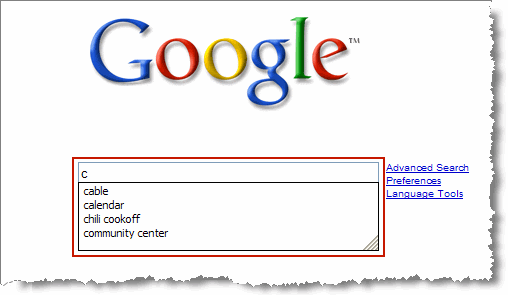
CNet asks "Is Google's user interface outdated?" The DOS C: prompt was displaced by graphical windows. Ironically, Google has displaced cluttered windows with a box that resembles DOS.

We have usage questions. Is Google a search engine? Or has it displaced the browser address box? How are millions really using Google?


Internet Portal

Users type and search. What are they typing?
  • About 25% of users type the website, domain, or partial name. For example, the top keywords for Facebook are facebook, facebook.com, www.facebook.com, and face book. A large percentage of users no longer use the address bar or bookmark sites.
  • Type ticker symbols and Google takes you to the financial data for a company.
  • Type an address and Google assumes a map search.
  • Type an area or zip code; Google returns a map.
  • Type 'define:word'; Google becomes a dictionary.
No doubt, Google will extend their distributed processing platform to handle people search like Spock.com and reverse phone number search. Google has become a portal for getting to places, quickly.

Does this account for one third or more of Google's use?

Replacing the Yahoo Directory

Yahoo started with a directory of web sites. Publishers submitted domain names by category. As the lists grew, Yahoo scrambled to create order.

For the most common keywords, Google has become the directory. Using the Google system that ranks entries based on cross-links, these keywords produce essentially the old Yahoo directory with relatively static choices. Google's ranking system favors historic links, thus the content does not change quickly.

Google has enhanced the directory with many features.
  • Relevant photos and videos have been integrated with the search results.
  • Moving toward the semantic web, lists of phrases that include the keyword appear at the bottom of these pages. This is similar to Yahoo's efforts to group related subdirectories as new pages.
  • For timely content, the news search only shows recent content. The content is still weighted to favor brands with long history and legacy cross-links.
  • Book, blog, and scholar search further segment the directory of relevant sites.
'Flypaper Effect'

As a blog, the Long Tail has little chance of becoming visible in the top pages of the Google's directory.

Successful search terms can be categorized as 'flypaper'. These unique combinations of names, trademarks, and other terms drive readers to us. Thousands of search terms each contribute a few hits; as opposed to one or two search terms that account for the majority of hits.

Flypaper accounts for the vast majority of search visitors.

Contextual Search

Google has been promoted as the intelligent search that contextually match searchers with content. After eliminating it's value as an Internet portal, Yahoo directory replacement, and flypaper tsunami - what percentage of the use is truly intelligent search based on context?

Analyze your data. What has been your experience?

Google: Okay To Be Evil Sometimes

by 

marissamayerbig.jpgIs Google done with its famous motto, "Don't be evil?" TechCrunch's Michel Arrington cites remarks by Google star Marissa Mayer in Australia that suggest that even Google is getting sick of this albatross:

Last week, however, Google's Marissa Mayer said 'It really wasn't like an elected, ordained motto' during an interview in Australia, adding 'I think that Don't Be Evil' is a very easy thing to point at when you see Google doing something that you personally don't like; it's a very easy thing to point out so it does get targeted a lot.'

Google's Selectively Optimized Contextual Targeting

Ed: Google search on advertising. Google is first. Manually optimized. Where is Yahoo, Microsoft??
Google Advertising
adwords.google.com      Bring targeted traffic to your site in minutes - Try Google AdWords.
How To Advertise
www.RippleTV.com      Show Your Ads In Local Shops On TV Screens. Simple. Try for $5!
Want More Customers?
www.valpak.com/advertise      Target Your Audience With Effective Direct Mail Solutions! Learn more.
Related searches:advertising careers advertising history advertising costs types of advertising

Advertising.com

The result: the advertiser gets the best ad placements possible across thousands of websites and the website earns more revenue by having Advertising.com ...
www.advertising.com/ - 13k - Cached - Similar pages

Advertising - Wikipedia, the free encyclopedia

Advertising is a form of communication whose purpose is to inform potential customers about products and services and how to obtain and use them. ...
en.wikipedia.org/wiki/Advertising - 106k - Cached - Similar pages

BidVertiser - Pay Per Click Advertising On Sites Of Your Choice.

Pay per click advertising - online advertising directly on sites of your choice, internet marketing solution for online advertisers.
www.bidvertiser.com/ - 69k - Cached - Similar pages

BidVertiser - Pay per click advertising on sites of your choice.

We use a pay per click advertising (ppc) model which means that you only pay for the clicks you receive. You choose how much you are willing to pay for each ...
www.bidvertiser.com/bdv/BidVertiser/bdv_advertiser.dbm - 69k - Cached - Similar pages

A Free Online Advertising Network | Free Blog Advertising ...

AdGridwork is a Free, Online Advertising and Link Exchange Network. We provide an automated service that serves your Ads and Text-Links on thousands of ...
www.adgridwork.com/ - 10k - Cached - Similar pages

Advertising Careers and Business Advertising Information

Get advertising career help for freelance copywriters and other ad pros and find insight for businesses needing advertising guidance as well.
advertising.about.com/ - 29k - Cached - Similar pages

WSJ Advertising

Wall Street Journal Advertising. WHAT’s NEW. The Wall Street Journal Honored With Two Pulitzer Prizes in 2007: Public Service and International Reporting ...
advertising.wsj.com/ - 12k - Cached - Similar pages

Advertising Age - Ad Age is the leading source of news, views and ...

A definitive general collection of news and analysis regarding goings-on in the world ofadvertising.
adage.com/ - 46k - Cached - Similar pages

Business Week Online: Advertising

Get advertising information on companies that have appeared in our directories, such as the MBA, Industrial Design and E-learning directories. ...
www.businessweek.com/advertising.htm - 25k - Cached - Similar pages

Google Advertising

Allows you to buy advertising on the Google search engine, or on other sites through its AdSense program. Includes a tour and FAQ.
www.google.com/intl/en/ads/ - 13k - Cached - Similar pages

Searches related to: advertising

advertising careers advertising history advertising costs types of advertising 
advertising tips advertising prices advertising campaigns newspaper advertising 

Ed: Drill down on online advertising costs. End of optimized directory.
Online Advertising
www.google.com      Maximize revenue with targeted ads. Try Google advertising programs.
Online Press Release
www.prweb.com      The most cost effective way to market your business locally!
Facebook Advertising
www.facebook.com/ads/      Reach the exact audience you want with relevant targeted ads.

Online advertising - Wikipedia, the free encyclopedia

Though, as seen above, the large majority of online advertising has a cost that is brought about by usage or interaction of an ad, there are a few other ...
en.wikipedia.org/wiki/Online_advertising - 39k - Cached - Similar pages

Online Advertising May Cost More Than You Think - ClickZ

Do you really know how much you spend to acquire customers online?
www.clickz.com/showPage.html?page=3427421 - 83k - Cached - Similar pages

Internet Advertising Cost

A question I get a lot is "What does it cost for Internet advertising?" I'm almost tempted to tell people, whatever they want to spend. ...
ezinearticles.com/ ?Internet-Advertising-Cost&id=517472 - 46k - Cached - Similar pages
[PDF] 

Online Advertising: Costs vs. Effectiveness We provide rules that ...

File Format: PDF/Adobe Acrobat - View as HTML
the true costs of online banner advertising and opt-in e-mail. marketing compared to traditional print (offline) marketing. campaigns. ...
www.forbes.com/fdc/ mediaresourcecenter/documents/gertner.pdf - Similar pages
[PDF] 

Internet Advertising and the Generalized Second Price Auction ...

File Format: PDF/Adobe Acrobat - View as HTML
used by search engines to sell online advertising that most Internet ..... The ease of use, the very low entry costs, and the transparency of the mechanism ...
rwj.berkeley.edu/schwarz/publications/gsp051003.pdf - Similar pages

CPA - The Holy Grail of Online Advertising? - ReadWriteWeb

Aug 14, 2006 ... This article explores the new online advertising model of CPA (Cost per Action/Acquisition) and determines whether it will be The Next Big ...
www.readwriteweb.com/archives/cpa_holy_grail.php - 33k - Cached - Similar pages

Quick jump navigation

Jul 6, 2006 ... It is the fastest-growing segment of the online advertising market (see ....Instead, advertising becomes a variable cost of production that ...
www.economist.com/business/ displaystory.cfm?story_id=7138905 - Similar pages

Online Advertising Costs Expected to Surpass Newspaper Advertising ...

Aug 8, 2007 ... Greg Sterling over at Search Engine Land posts a startling (but not surprising) report that internet ad spend will surpass traditional media ...
www.seroundtable.com/archives/014424.html - 26k - Cached - Similar pages

Online Advertising: How much online video advertising costs

Dec 18, 2007 ... Almost as bad as the user-generated video flooding the Web is the professionally generated stuff Newspapers are thrusting nebbishy ...
valleywag.com/tech/online-advertising/ how-much-online-video-advertising-costs-335195.php - Similar pages
[PDF] 

Internet Advertising and the Generalized Second-Price Auction ...

File Format: PDF/Adobe Acrobat - View as HTML
engines to sell online advertising. Although GSP looks similar to the ..... transition costs: VCG revenues are lower than GSP revenues for the same bids, ...
www.benedelman.org/publications/gsp-060801.pdf - Similar pages
Ed: Long Tail for advertising information. No SEM ads. Not optimized.
   
 Web Personalized Results 1 - 10 of about 391 for economics, flypaper, SEO. (0.04 seconds) 

New Economics of Advertising: HOW-TO: SEM or 'Flypaper Effect' for ...

HOW-TO: SEM or 'Flypaper Effect' for Attracting Readers. What draws more readers: search engine optimization or the 'flypaper effect'? SEM and SEO Revisited ...
adecon101.blogspot.com/2008/ 03/how-to-sem-or-flypaper-effect-for.html - 92k -Cached - Similar pages

New Economics of Advertising: STATS: Paid versus Natural Search Clicks

Simplify the technologies behind the new economics of buying and selling ... Ed: Flypaperbeats natural SEO. Accidental+habitual clicks approximate paid ...
adecon101.blogspot.com/2004/06/ stats-paid-versus-natural-search-clicks.html - 108k -Cached - Similar pages
More results from adecon101.blogspot.com »

FROM JOURNALS Andrew F.

P.G. WyckoE The Elusive Flypaper Effect. K.T. Duffy-Den0 and R.W. Eberts: Public Infrastructure and Regional Economic Development: A ...
www.blackwell-synergy.com/doi/ pdf/10.1111/j.1467-9787.1992.tb00174.x - Similar pages

Why The Community CEO Doesn't Work | CenterNetworks

Nov 14, 2007 ... While SEO directory products like Mahalo have low switching costs, ....announcement like flypaper to social media advocates across the web. ...
www.centernetworks.com/community-ceo-does-not-work - 42k - Cached - Similar pages

EconPapers: Policy Research Working Paper Series

Niggol Seo and Robert Owen Mendelsohn; 4163: A Ricardian analysis of the impact ... Adam Wagstaff; 4133: Fungibility and the flypaper effect of project aid: ...
econpapers.repec.org/paper/wbkwbrwps/default4.htm - 36k - Cached - Similar pages

Ed: QED

Support Our Sponsors: