[ About Us | Popular | Marcom | AdNet | IChannel | Glossary ]
Showing posts with label news sources. Show all posts

Apr 12, 2009

CLIP Does Google Really Control The News?

Ed: 
  • Google Search can be up to 80% of a site's traffic source.
  • Traffic deep-links into a site, bypassing the home page. 
  • Users read 1.x page and leave, arriving another day via search.
  • Google has become the primary navigation for a website. Sophisticated navigation for a website serves little purpose.
  • Few publishers understand the reality of how news distribution has changed.
Once again, Google is the favorite bogeyman responsible for the rapid deterioration in the health of the news industry. This time it is Nick Carr doing the finger-pointing, describing Google as the most powerful middleman in news:

When a middleman controls a market, the supplier has no real choice but to work with the middleman - even if the middleman makes it impossible for the supplier to make money.

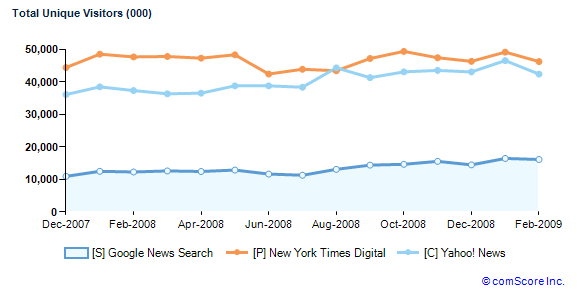
So how powerful is Google when it comes to parceling out traffic to news sites? If you are talking about Google News, the answer is that it is not quite as powerful as you might think. In the U.S., Google News is overshadowed by both Yahoo News and even the sites controlled by the New York Times (which includes NYTimes.com, Boston.com, HeraldTribune.com, and several other newspaper sites). According to comScore, Google News attracted 16.2 million unique visitors in the U.S. in February, compared to 42.3 million for Yahoo News and 46.2 million for the sites operated by New York Times Digital.

So Google News is not the middleman here. Let’s just put that notion to rest. Yahoo News is three times as large, and Yahoo sends even more traffic to newspaper sites from other parts of Yahoo through its onlinenewspaper consortium.

The bigger question is whether Google as a search engine is controlling access to news sites. That really seems to be Carr’s main concern, although it is not clear because he uses a Google News search as his main example. Nevertheless, Google’s main search engine is certainly a major source of traffic to information sites of all stripes. At TechCrunch, for instance, it is the single largest source of traffic, accounting for about a third of the total. I have no idea whether this is representative of other news sites, but it wouldn’t surprise me. Google search is a very important middleman indeed.

Does that make Google like Wal-Mart, as Carr suggests, a middleman of such might that it squeezes everybody else’s margins? Does that give it “monopoly control over content distribution,” as Scott Karp tries to argue? Not exactly. Information economics work slightly differently than retail economics. Let me stick with the TechCrunch example. One third is a lot, but it is not a monopoly. Google sends us all of that traffic because many of our posts rank highly for the topics they cover. We don’t pay them for that traffic. We are not buying keywords.

Yes, Google makes money from other ads shown besides any searches where TechCrunch posts shows up as results. But the money Google makes from those ads does not detract from our revenues. Quite the opposite. Those searches send a considerable amount of traffic to our site, where we have our own ads. The more people who see those ads, the more we can charge for them. It’s all good.

Google does not control the news, it exposes it.

The retail/distributor analogy is all wrong. Information is not the same as a flat-screen TV or a blender. It does not become less valuable the more available it is because all news is not the same. Information dissemination is not a zero-sum game. Carr and Karp would have you believe otherwise. Karp writes:

The more content there is on the web, the less money every content creator makes, and the more money Google makes by taking a piece of that transaction.

Again, that is not how it works. Google doesn’t force suppliers of information to charge less for it as Wal-Mart does with suppliers of packaged goods. The money Google makes from its search ads is not necessarily money that would have otherwise gone to a “news” or content site. If Google didn’t exist, those ad dollars might have gone to an e-commerce site or a travel site or a real estate site or any number of other places. News sites have no claim to those search advertising dollars. It is incumbent upon each of us to attract an audience by having something original or interesting to say. When news sites do that, other sites link to them, and then they rank more highly in Google search results, which sends new readers their way.

And then once those readers do find a news source they trust, you know what? Some of them actually keep coming back on their own volition without Google telling them what to do. That is called direct traffic. Or they come through other sites. Google isn’t the only one who benefits from all those links. If you want to be known as an authoritative source of news, it is no longer good enough to simply proclaim yourself to be one.

Nov 28, 2008

CNN quakes as Twitter keeps pace with Mumbai news

CNN quakes as Twitter keeps pace with Mumbai news

It’s one thing when a couple dozen or so tech blogs rally around the idea that Twitter is an excellent source for the quick dissemination of news in a time of crisis — many of us have been trumpeting this fact for months if not longer — but it’s another when CNN (and not one of CNN’s blogs, but CNN proper) says the same thing.

One of the top headlines today on CNN.com is titled “Tweeting the terror: How social media reacted to Mumbai.” The opening sentence of the piece is even more to the point: “It was the day social media appeared to come of age and signaled itself as a news gathering force to be reckoned with.”

While CNN and other mainstream publications have been slow to credit online services like Twitter in the past for breaking news during times of crisis, like earthquakes and wildfires, they’re definitely coming around. It shouldn’t really be a surprise that CNN is the one saying this either. One of their anchors, Rick Sanchez, has been very active in the Twitter community, using the micro-messaging service to help with his reporting for several months now.

“Yes, Twitter is a source of journalism,” as blogger Mathew Ingram puts it.

But CNN isn’t quite as rosy about Twitter’s “reporting” capabilities as Ingram — after all, they don’t want it taking their jobs. Noting the widespread rumors and inaccuracies that began to pop up on Twitter about the attacks alongside true reports, CNN warns that “while Twitter remains a useful tool for mobilizing efforts and gaining eyewitness accounts during a disaster, the sourcing of most of the news cannot be trusted.”

That, of course is true, but as Ingram notes, when some wrong information started appearing on Twitter about the attacks, other users were quick to correct the reports — and again, those corrections probably happened quicker than they would have at traditional media outlets.

It’s really a question of speed versus 100 percent accuracy. In many cases, you have to take one over the other. In a time of crisis, I would guess that just about everyone would choose speed. And in that regard, organizations like CNN simply cannot match a service like Twitter, which has millions of potential “reporters.”

The old adage, “don’t believe everything you read,” is still important to keep in mind when getting information from Twitter. But it’s precisely an “old adage” because it’s been around long before Twitter ever existed and will be around after it’s gone. Twitter is just another source, granted a very fast one, but it still requires the ultimate filter: Your brain...

Twitter kills Canadian SMS updates. Can the U.S. be far behind?

As regular readers know, I hate SMS (text messaging). It’s not the idea or technology that I hate, it’s just the ridiculous costs associated with it. Why should I pay AT&T $15 a month for unlimited text messages (tiny amounts of data) when I already pay $30 a month for “unlimited” data?

So in some ways I’m happy that more people’s hatred for the service will grow today with the news that Twitter is ending outbound SMS updates in Canada.

The quiet killing of this feature (made on the Twitter Status blog rather than the main Twitter blog), is due to “unexpected changes in our [Twitter's] billing,” according to the post. The arrangement Twitter had negotiated with Canadian mobile carriers to send Twitter updates via text (which Twitter was subsidizing) has apparently seen costs double multiple times over the past several months.

To be clear, while sending Twitter updates via the Canadian shortcode (21212) will still work, receiving any Twitter updates will no longer be an option. This renders the service almost useless.

Canada is not the first to see Twitter SMS updates get the axe. In fact, it was one of only three where the service actually still worked when the company last announced it had to kill SMS in some countries back in August. Now the U.S. and India remain as the only countries with full SMS support for Twitter.

It seemed like those countries, along with Canada may have been safe because of established relationships with carriers — but that is clearly not the case. So you have to wonder, how long until the service is cut in the U.S. and India?

I don’t blame Twitter here, I blame the operators and their greed when it comes to SMS. It’s almost 2009 and we’re still paying upwards of 20 cents to send 160 characters (or ridiculous monthly rates). It’s nearly a $100 billion industry, with profit margins near 90 percent. It’s a scam.

Nov 14, 2008

News at Seven Website replaces anchors, reporters with virtual technology

US: Website replaces anchors, reporters with virtual technology

A new website designed by the Intelligent Information Laboratory at Northwestern University is removing the need for humans in the news broadcasting and reporting process, according toNowToronto.

News at Seven "collects news stories from the web, edits them automatically and formats the content for artificial anchors," creating a complete editorial package, pulling relevant images and blogs from the web to "complement" the story.

May 26, 2008

NEWS: This Week in Silicon Alley (May 26-30) - News Hounds

Ed notes: Fighting for the first-hand fact gathering advantage (getting the scoop over other sources):
  • Sillicon Alley Insider: Wall Street events
  • Techcrunch: Silicon Valley events
  • Engadget: Patents for future products
  • Techdirt: User submitted rumors
  • Digg: User promoted rumors
Equal access events: corporate blogs, legacy press releases, Wall Street earnings announcements. 

Technology/money-making how-to: The best methods are proprietary. Why earn pennies with blogging when true innovations can be worth millions?

This Week in Silicon Alley (May 26-30)

Monday, May 26

  • MEMORIAL DAY

Tuesday, May 27

  • Before the bell: Vodafone (VOD) preliminary earnings webcast, 5:00 a.m.
  • SeedingIt.com: Global Seed Capital Network Meeting, 6:00 p.m.
  • NY Web Analytics May Meeting, 7:00 p.m.

Wednesday, May 28

Thursday, May 29

Friday, May 30

Apr 13, 2008

NEWS: The Twenty Best Financial Blogs

Ed: Research to extend news sources. East coast advantage.

Footnoted.org (http://www.footnoted.org/).
This site, run by business journalist Michelle Leder, does a lot of digging into public filings. Ms. Leder’s work shows a passion for detail, and an excellent working knowledge of SEC filings. She posts about once a day. Alexa Three Month Ranking:151,421.
Frank Barnako’s Media Blog (http://blogs.marketwatch.com/barnako)
The author primarily covers media and the internet. Barnako picks up good blogs on these subjects from a number of other sites, and his blog usually puts up three or four new posts a day. Alexa Three Month Ranking for Marketwatch.com which hosts Barnako: 466.
GannonOnInvesting (http://www.gannononinvesting.com/)
Geoff Gannon writes as well as any senior editor at Forbes or Forture. We just wish he wrote more often. His recent series on large banks is a classic and shows that financial blogs can match analysis and writing style with anything mainstream media has to offer. Alexa Three Month Ranking: 350,569
The microcap speculator (http://www.microcapspeculator.blogspot.com/)
This is the best sites for analysis of stock with very small market capitalizations. Many of the stocks written about here trade on the Bulletin Board and Pink Sheets. The site covers individual companies, insider buying at microcaps and the short interest in small companies, which is probably where most naked shorting goes on. Alexa Three Month Ranking: 1,213,359.
Stock Market Beat (http://www.stockmarketbeat.com/)
William Trent, the author of StockMarketBeat is a certified financial analyst. It shows. Trent is especially good at covering the semiconductor market, but he takes on everything from retail companies to personnel firms. The research is extraordinary and often links to very interesting studies. The site usually has two new posts a day. We are begging Trent to put his site onto something like blogger. Navigating StockMarketBeat is almost as interesting as the articles, which is too bad. Alexa Three Month Ranking: 836,228 (24/7 Wall St runs some of StockMarketBeat’s articles.)
Berkshire Ruminations (http://berkshireruminations.blogspot.com/)
Andy Kern, who writes this blog, is a devotee of Warren Buffett. But, a lot of the posts he writes have nothing to do with Buffett. The coverage of economic trends and specific companies shows a keen eye for the market. Kern does not post often, and due to that almost didn’t make this list, but what is posted is good enough to make up for low volume. Alexa Three Month Ranking: Not Ranked
The Kirk Report (http://www.thekirkreport.com/).
This site is a combination of solid writing on companies and the markets by Charles Kirk and includes a large number of references to other financial blogs and websites that cover a spectrum of stock market and economic subjects. A trip to the site is like going to a current events library on the markets. Alexa Three Month Traffic Ranking: 51,041.
TraderFeed (http://www.traderfeed.blogspot.com/)
Brett Steenbarger’s site was chosen because it is not only clearly very good, but takes a completely different perspective on the market than we do. The site primarily posts about the market based on trends that may go back years and includes psychological insights regarding the skills and personalities of traders. The author posts very regularly. Alexa Three Month Traffic Ranking: 170,591.
SeekingAlpha (http://www.seekingalpha.com/)
This large website runs 40 or 50 articles a day by both in-house staff and contributors. Subjects range from individual companies in both the US and overseas markets to exchange traded funds and includes personal financial advice. SeekingAlpha runs transcripts of large company conference calls and summaries of Jim Cramer’s comments and the Wall Street Journal. Alexa Three Month Traffic Ranking: 8,668.
Ticker Sense (http://www.tickersense.typepad.com/).
Ticker Sense is put out by Birinyi Associates, a firm that provides research to institutional investors. It shows. The authors put up one or two posts a day, usually with charts. Recent post have included global exchange traded funds that are overbought or oversold, an historical look at monthly employment trends, and a look at Pepsi’s trading range. The articles are well-written and the analysis is outstanding. Alexa Three Month Traffic Ranking: 251,409.
ModernGraham.com (http://www.moderngraham.com/)
The people who started this blog are followers of the investment philosophies of Benjamin Graham and Warren Buffett. The authors post technical screens of stocks based on financial characteristics like defensive shares that trade at high return on investment capital. Companies are also analyzed based on Buffet’s Business and Management Review. All of it is thought provoking even if you don’t agree with Graham or Buffett. Alexa Three Month Traffic Ranking:3,103,703.
TheStockMasters (http://www.thestockmasters.com/)
This site is written by a group of investors including financial advisors and day traders. Posts are usually done a few times a week and cover stocks and options. Recent stories on Sprint and Ford were particularly well-done. Alexa Three Month Traffic Ranking: 5,180,713.
BloggingStocks (http://www.bloggingstocks.com/)
This site is part of the weblogsinc division of AOL. One of the site’s writers, Brian White, writes almost half of the 400 posts per month. His work is consistent and well-researched. His output is amazing. Most of the posts at BloggingStocks cover eight companies: Apple, GE, Microsoft, Wal-Mart, eBay, Google, Time Warner, and Yahoo!. The site has about 15 regular contributors, so the coverage of each of the companies is very complete and well-edited. (24/7 Wall St. contributes articles on Time Warner under contract with Bloggingstocks.) Alexa Three Month Traffic Ranking: 27,484.
Hilary On Stocks (www.journals.aol.com/hilaryonstocks/hilaryonstocks).
Hilary Kramer writes about stocks for AOL Finance. Most of her posts cover individual public companies. The analysis reads like a string of high-end research reports. Companies cover a range of small caps to Fortune 500 companies. Alexa Three Month Traffic Rank: based on AOL which hosts this blog, but not the blog itself: 36)
Value Discipline (http://www.valuediscipline.blogspot.com/)
The author is a former portfolio manager who ran institutional money. The majority of the posts, about one a day, cover companies and mutual funds. Recent posts on Tesco and corporate governance were particularly good. (24/7 Wall St. sometimes runs posts from Value Discipline.) Alexa Three Month Traffic Ranking: 580,006.
Random Roger’s Big Picture (http://www.randomroger.blogspot.com/)
Random Roger writes about anything and everything in the financial world, and most of it he does very well. Recent posts cover the ING Russia Fund, the number of months the market has been down each year since 1982, and the market’s 200 day moving average. The guy has interests, and expertise, that are that broad. Alexa Three Month Traffic Ranking: 241,389.
Equity Investment Ideas (http://www.equityinvestmentideas.blogspot.com/)
This site is written by Yaser Anwar. He writes a great deal about energy and metals, but also covers individual stocks. Anwar does a lot of technical analysis, well illustrated by charts. Some posts rely too much on text from other media, but, in general, the content is intelligent and unique. (24/7 Wall St. sometimes runs posts from Equity Investment Ideas.) Alexa Three Month Traffic Ranking: 1,537,147.
Absolutely No DooDahs (http://www.billakanodoodahs.com/)
The posts at this site cover almost everything in the equity investing world. Recent articles include the hurdles for the Chinese car companies that want to sell cars in the US and a long, in-depth piece on WD-40. Almost every article has a thoughtful angle. Alexa Three Month Traffic Ranking: 796,797.
Street Insider.com 13D Tracker (http://www.13dtracker.blogspot.com/)
SEC filings are a goldmine of information for investors. Very few people have the time or background to work through all of the documents filed by public companies to figure out those that are important. Virtually everyday this site posts data on which investors are increasing or decreasing holdings in public companies. This kind of content is hard to find, especially when someone smart has already evaluated it. Alexa Three Month Traffic Rank: Not Ranked.
The Average Joe Investor (www.theaveragejoeinvestor.blogspot.com)
Joe does not write much anymore, but we are going to give him the benefit of the doubt and hope he takes up the pen more often. Some of the posts here analyzing companies are as good as any on the web. Joe shares this ability with Geoff Gannon. Recent posts on Amphenol and “Dealing With A Down Market” are outstanding. Alexa Three Month Traffic Rank: 2,091,290.
 Wall Street's Top Analysts 
Edited by Andrew T. Gillies, 05.03.04, 6:00 AM ET 

Who are the best brokerage analysts? We teamed with StarMine, a San Francisco-based research firm, to find out. Based on StarMine's extensive analysis of 2003 data, we learned which analysts racked up the biggest gains overall and industry by industry. We also found out who the sharpest shooters were for earnings estimates.
Full story > 

In Pictures

 
Top Stock Pickers
 
Top Earnings Estimators

Wall Street's Best Stock Pickers

  1. Smith Barney Citigroup's Stephen Kim
  2. FTN Midwest Research's Brett D. Rabatin
  3. Wedbush Morgan Securities' Scott P. Sutherland
  4. Stifel Nicolaus & Co.'s John M. Roberts
  5. JMP Securities' Jim J. Fowler
  6. Wachovia Securities' Jennifer M. Fritzsche
  7. Wachovia Securities' Jonathan Wolff
  8. Prudential Equity Group's Andrew F. Rosenfeld
  9. Friedman Billings Ramsey's Scott Valentin
  10. Sandler O'Neill's Richard H. Repetto

Firms Winning Most Awards

FirmNumber Of Awards
Smith Barney Citigroup18 - 7 Pickers9 Estimators 
      2 Top Ten Placements
Goldman Sachs12 - 5 Pickers7 Estimators
J.P. Morgan12 - 7 Pickers5 Estimators
Legg Mason12 - 9 Pickers3 Estimators
Prudential Equity Group10 - 4 Pickers5 Estimators 
       1 Top Ten Placement
Lehman Brothers10 - 4 Pickers6 Estimators
Deutsche Bank  9 - 3 Pickers6 Estimators
Piper Jaffray  9 - 3 Pickers5 Estimators 
       1 Top Ten Placement
UBS  9 - 2 Pickers5 Estimators 
       2 Top Ten Placements
Wachovia Securities  8 - 3 Pickers3 Estimators 
       2 Top Ten Placements


NEWS: The Wizards of Buzz

A new kind of Web site is turning ordinary people into hidden influencers, shaping what we read, watch and buy.

...Though it can take hundreds or thousands of votes to make it onto the hot list at these sites, the Journal's analysis found that a substantial number of submissions originated with a handful of users. At Digg, which has 900,000 registered users, 30 people were responsible for submitting one-third of postings on the home page. At Netscape.com, a single user named "STONERS" -- in real life, computer programmer Ed Southwood of Dayton, Ohio -- was behind fully 217 stories over the two-week period, or 13% of all stories that reached the most popular list. (Netscape, which gained fame with its namesake browser, is now owned by Time Warner's AOL unit and operates a news site.)

On Reddit, one of the most influential users is 12-year-old Adam Fuhrer. At his desktop computer in his parents' home in the quiet northern Toronto suburb of Thornhill, Mr. Fuhrer monitors more than 100 Web sites looking for news on criminal justice, software releases -- and the Toronto Maple Leafs, his favorite hockey team. When Microsoft launched its Vista operating system this year, he submitted stories that discussed its security flaws and price tag, which attracted approving votes from more than 500 users.

The Influencers

A look at some of the hidden influencers deciding what is popular on the Internet.

Social Issues

PAMELA DREW/"Pamela Drew"
POSTS ON: Newsvine
WHO SHE IS: A mother of three in New York
HOW SHE DOES IT: She spends at least two hours a day looking for stories about genetically modified foods, which she says isn't covered enough in the media. Her opinionated articles have fueled her reputation; 272 of her postings have been particularly well-received.

DIANE PUT/"idyll"
POSTS ON: Netscape/Reddit
WHO SHE IS: A nutritionist in Idyllwild, Calif., who tracks health issues
HOW SHE DOES IT: Ms. Put got her first taste of social networking in 1988 when she joined "The Well," an early online community. She is now ranked 10th on the top-user list. "I got addicted to the vote," she says about her involvement.

KARIM YERGALIYEV/"supernova17"
POSTS ON: Digg
WHO HE IS: An information-systems major at the University of Maryland
HOW HE DOES IT: While many users rely on hundreds of sites for stories, Mr. Yergaliyav says he only monitors about 20, including mainstream ones like Business Week and ESPN. He checks his sites once in the early morning and again after lunch so he doesn't miss any updates.

DEREK VAN VLIET/"BloodJunkie"
POSTS ON: Netscape
WHO HE IS: A 27-year-old computer programmer
HOW HE DOES IT: At Digg, Mr. Van Vliet says he cultivated friendships with other users, which helped drive interest in his postings: That renown earned him a place at Netscape, where he now gets paid to post links.

Technology

HENRY WANG/"dirtyfratboy"
POSTS ON: Digg/Netscape
WHO HE IS: A high-school senior and varsity tennis player outside of Chicago
HOW HE DOES IT: In August, Mr. Wang posted a link to a new social-networking site Famster, saying, "I can't believe this site isn't widely known." The link got 1,700 votes and bumped Famster's daily visits to 50,000 in a day.

CLIFF WORTHINGTON/"CLIFFosakaJAPAN"
POSTS ON: Digg
WHO HE IS: A 45-year-old English teacher in Osaka, Japan
HOW HE DOES IT: Living in Osaka -- in a time zone 14 hours ahead of many Digg users -- gives him an edge on breaking news. He posts news about Apple and calls Digg's decision to yank its leaderboard "a slap in the face."

BLAKE REITZAMMER/"fatmike"
POSTS ON: Digg
WHO HE IS: A computer consultant in Miami
HOW HE DOES IT: Since joining in June 2006, he's submitted more than 3,000 links -- or roughly 100 every week. Microsoft is a pet topic.

NEIL PATEL
POSTS ON: Digg
WHO HE IS: A college senior and chief technology officer of an Internet-marketing company
HOW HE DOES IT: "Sometimes I overthink it," he says about his habit of studying a site before posting it. With so many people now using Digg, Mr. Patel says it's getting harder for him to discover a site first.

SMARAN DAYAL/"koregaonpark"
POSTS ON: Digg
WHO HE IS: An 18-year-old avid video gamer in Pune, India
HOW HE DOES IT: For the rabid Apple fans who populate the Internet and feed sites like AppleInsider.com, Mr. Dayal is something of a expert. He's often the first to pick up on issues affecting Apple, from controversy over music licensing to proposed legislation to ban iPods on city streets.

Breaking News

CHRISTOPHER THOMAS/"Killfile"
POSTS ON: Newsvine
WHO HE IS: A self-proclaimed "news hound" and the site's top user
HOW HE DOES IT: He subscribes to dozens of RSS feeds and constantly checks major media sites here and abroad. He submits around noon "to take advantage of the lunch rush hour," and as a "citizen journalist," was one of the first to report a story on an August 2006 Virginia shooting.

CURTISS THOMPSON/"curtissthompson"
POSTS ON: Digg
WHO HE IS: A 19-year-old college student
HOW HE DOES IT: Technology news was an easy choice for Mr. Thompson, a computer-science major. He watches sites like CNET closely for the latest developments about digital music and podcasts.

ED SOUTHWOOD/"STONERS"
POSTS ON: Netscape
WHO HE IS: A computer programmer in Dayton, Ohio
HOW HE DOES IT: In our analysis, more than 200 of Mr. Southwood's stories made it to the front page, accounting for 12% of all popular submissions.

MARK JOHNSON/"aidenag"
POSTS ON: Digg/Netscape
WHO HE IS: A photographer in Seattle
HOW HE DOES IT: Working out of his home office, Mr. Johnson says he goes through 2,000 Web sites a day looking for the coolest news on left-leaning politics and science. He says he got some help from user Mr. Van Vliet, whom he emailed shortly after joining Digg for tips on how to boost his popularity.

Video/Photography

JEFF HOARD/"Fedquip"
POSTS ON: Del.icio.us/Reddit/Netscape
WHO HE IS: A 25-year-old worker in a shipping warehouse in Victoria, British Columbia
HOW HE DOES IT: He got a Netscape contract after becoming a top user on Reddit, which he says he joined to draw attention to his site, ThrowAwayYourTV.com, a clearinghouse for video clips.

PAMELA THILO/ "anonymgrl"
POSTS ON: Reddit
WHO SHE IS: A part-time Montessori school teacher from Cambridge, Mass., who helps run a small independent record label.
HOW SHE DOES IT: She submits political and science news -- discovered over morning coffee or evenings at work -- but says photos and videos can be a surer way to hit the home page. Her strategy for finding videos: revisiting YouTube users who've had hits in the past to see what clips they've uploaded lately.

ILCIN TURKKAN/ "Tutto"
POSTS ON: StumbleUpon
WHO HE IS: Originally from Turkey, he now lives in Bergamo, Italy, where he runs an antique-rug store
HOW HE DOES IT: While waiting for customers at his store, the photography enthusiast searches the Web for compelling images, ranging from the surreal and photoshopped to the stark and political. He says his postings are very mood dependent -- some days he'll post 30 photos, some days none.

Culture

ADAM FUHRER
POSTS ON: Reddit
WHO HE IS: A 12-year-old hockey fan in Toronto
HOW HE DOES IT: Mr. Fuhrer has helped raise questions about whether electronic voting machines can be hacked, and the shortcomings of Microsoft's operating systems. His mother's content blocker prevents him from visiting sites like YouTube.

ANGUS FRASER/"angusf"
POSTS ON: Del.icio.us
WHO HE IS: A graduate student in film and television in Sydney, Australia
HOW HE DOES IT: Mr. Fraser has bookmarked more than 30,000 Web sites on his Del.icio.us page, more than any other user, according to the company. Because he joined Del.icio.us in its early stages, many of the sites he tagged first -- including a site that connects companies with freelancers, Elance.com -- have gone on to hit the "popular" page.

ELISE BAUER/"elisebauer"
POSTS ON: Del.icio.us
WHO SHE IS: A marketing consultant in Carmichael, Calif.
HOW SHE DOES IT: Ms. Bauer's bookmarks comprise hundreds of recipes on her food blog (some her own, and some discovered on other blogs), and make her somewhat of a maverick on this tech-heavy site.

MARK NUNES/"cineaste"
POSTS ON: StumbleUpon.com
WHO HE IS: A film lover in Chicago

HOW HE DOES IT: He searches for articles on foreign films, philosophy and religion, trying to find authors who are already popular. Anything by Richard Dawkins, he says, generates a lot of buzz.


Apr 7, 2008

List of New York Newspapers

New York

This is a list of all daily newspapers in New York state. For weeklies, please see List of newspapers in New York


Support Our Sponsors: