[ About Us | Popular | Marcom | AdNet | IChannel | Glossary ]

Mar 31, 2009

Magazines Reap Most Ad Value Per Minute

Ed: Too little, too late.

mpa-time-ad-impact-ratio-march-2009pg.jpg

Magazines Reap Most Ad Value Per Minute

Magazines have 5.5 times more ad influence relative to the time spent with them, a multiple that is higher than for any other major media, according to an analysis of consumer time spent with media conducted by the Magazine Publishers of America (MPA), writes Media Buyer Planner.

mpa-time-ad-impact-ratio-march-2009pg.jpg

The study is an attempt to make the measurement of advertising more meaningful by linking time spent with a medium directly with advertising outcomes.  The study assigns a score - or Ad Value Per Minute - to valuate the time readers spend with the advertising in each of the major media.

“One of the things that is important in understanding how advertising works is to separate the consumer relationship with the medium from the consumer relationship with advertising in the medium,” said Ellen Oppenheim, CMO of the MPA. Very often, she said, people look at time spent as a leading indicator of advertising engagement, rather than time spent with the advertising itself.

To help marketers address this issue, the MPA linked time spent with media to ad impact by using third party sources. The resulting metric, dubbed the Time-Ad Impact Ratio, can “help marketers to evaluate time spent in a way that aligns with their desire for better results,” said the MPA.

Perhaps unsurprisingly, the MPA discovered that magazines index with more than twice the impact of TV, online or radio, and are considerably higher than printed newspapers.

The Time-Ad Impact Ratio shows the following rankings, which differ significantly from those that exist if time spent is examined in isolation (without regard to results):

  • Magazines emerge as the leading medium with 5.5 times more ad influence relative to the time spent with magazines on an average day
  • Newspapers rank second with 4.9 times more ad influence relative to time spent
  • The internet has 2.5 times more ad influence relative to time spent
  • TV has 2.3 times more ad influence relative to time spent
  • Radio has 1.1 times more ad influence relative to time spent

Oppenheim acknowledges that the studies are based on consumer perceptions about media rather than behavior and are therefore a guideline and not a gold standard nor a potential currency.

Mar 30, 2009

STATS IAB Reports Internet Advertising Grew 10 Percent Last Year; Outpacing TV

by Erick Schonfeld on March 30, 2009

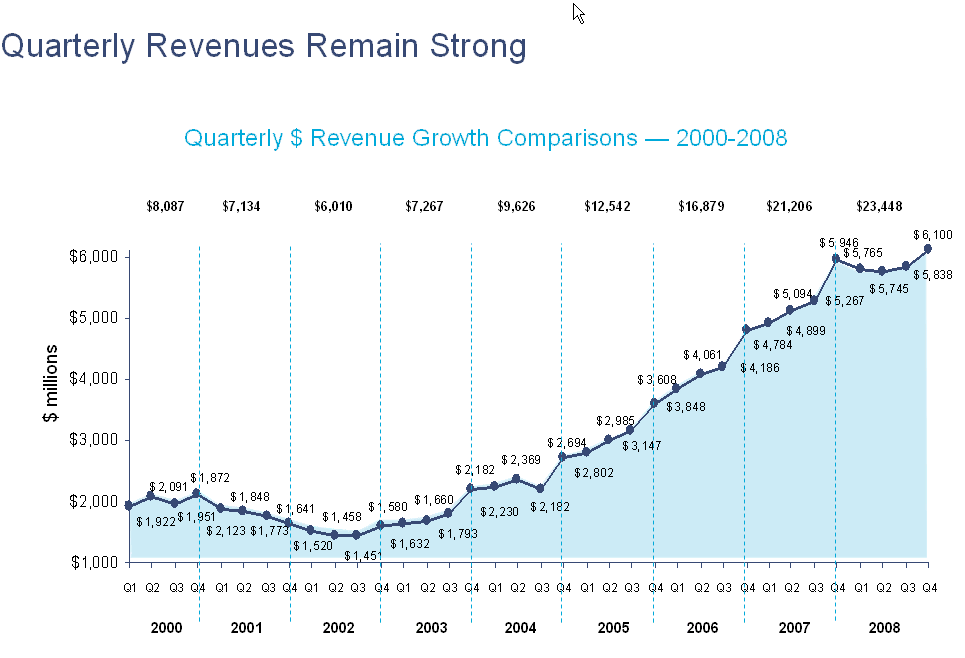
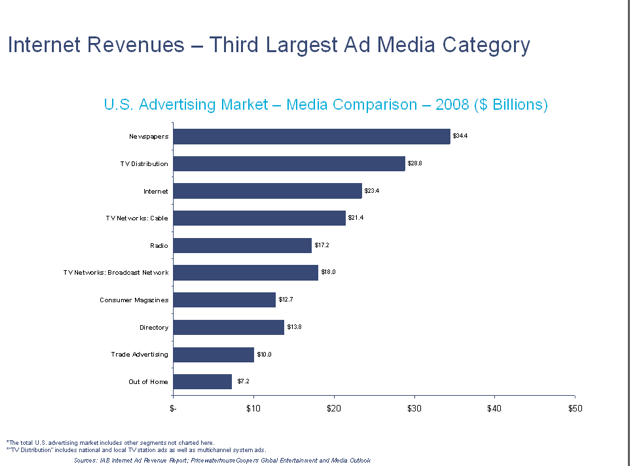
In an upbeat report this morning, the Interactive Advertising Bureau reported that internet advertising in the U.S. grew 10.6 percent to $23.4 billion. And the $6.1 billion fourth quarter (up 2.6 percent) was the first time Internet advertising surpassed the $6 billion mark. That said, the rate of growth declined both on an annual and quarterly basis. Even the 4.5 percent sequential growth over the third quarter was the lowest since 2002 (as was the annual growth rate).

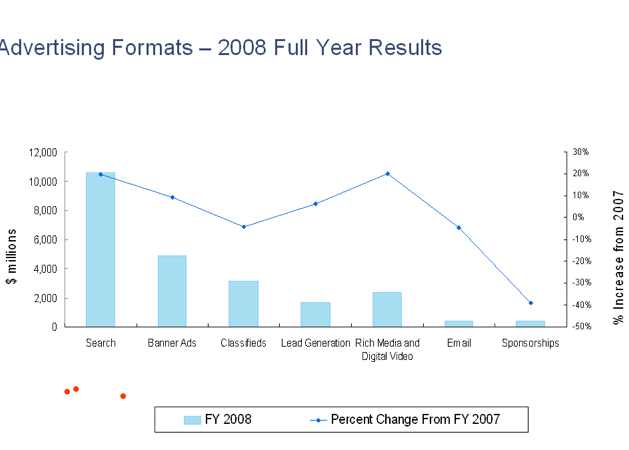
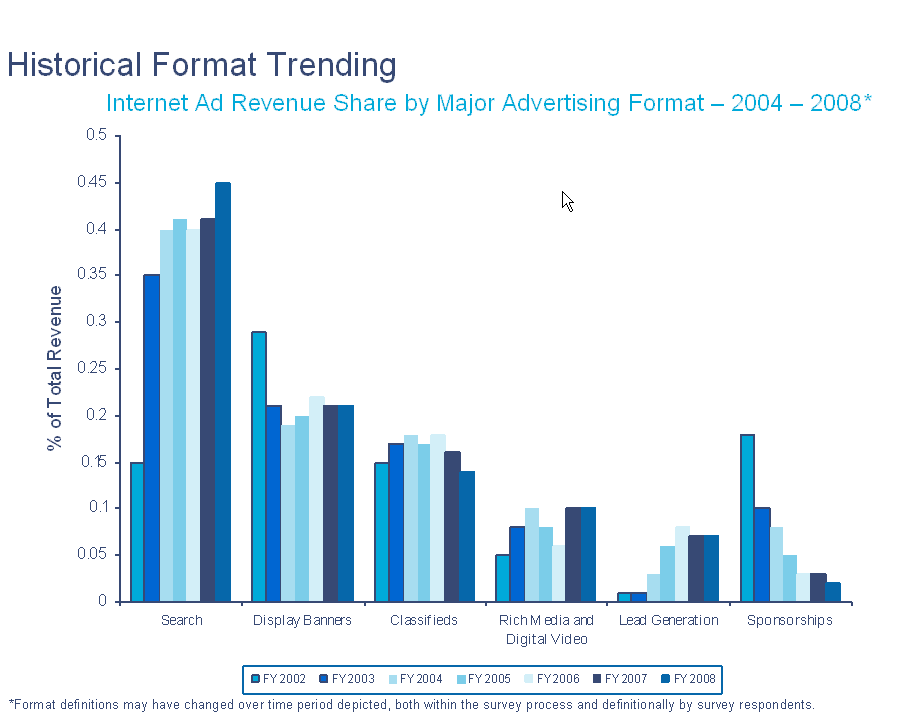
Search advertising dominated, with 46 percent of total Internet advertising market share. It also grew more than 20 percent for the year. The only category which grew as fast was rich media and video. Online video advertising grew faster than any other sub-category, with 123 percent annual growth (going from $324 million in 2007 to $724 million in 2008). Display advertising was able to eke out 8 percent growth for the year, but declined 4 percent in the fourth quarter.

iab-2008-ad-caegories

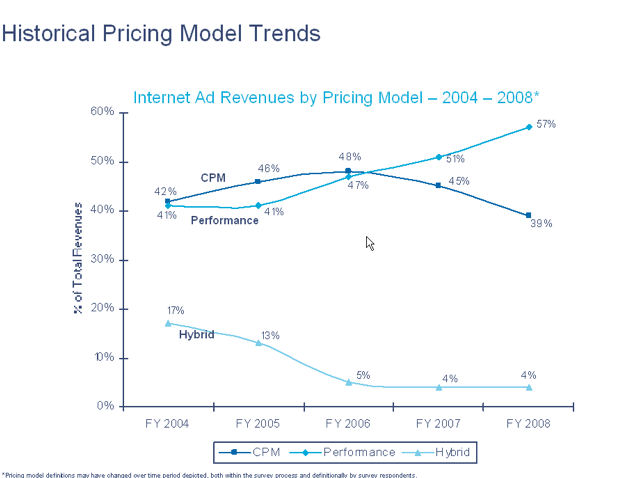
Performance-based advertising widened the gap over plain-vanilla impression-based advertising (CPM) last year, with 57 percent of all internet advertising revenues being performance-based versus 39 percent being CPM-based. That 18 percent gap widened from a 6 percent gap last year.

The IAB also trotted out some numbers showing that Internet advertising revenues are outpacing TV advertising by some measures. The $23.4 billion in annual internet advertising spending exceeded advertising on cable TV for the first time (which was $21.4 billion), and took the No. 3 spot behind national and local TV ads ($29.8 billion) and newspaper ads ($34.4 billion).

And in a new analysis comparing the first 14 years of Internet advertising revenues to the the first 14 years of cable and broadcast TV advertising, the IAB found that Internet advertising surpassed cable TV advertising in Year 4 ($907 million versus $499 million) and broadcast TV advertising in Year 10 ($9.6 billion versus $8.9 billion). Now, in Year 14, Internet advertising is almost twice as large as broadcast TV advertising was in its 14th year ($13.3 billion) and nearly four times as large as cable TV ($6.5 billion).

14year-comparisn-internet-vs-tv

Online Journalists More Optimistic About The Future Of Journalism than Print Peers

by Leena Rao on March 30, 2009

The Pew Research Center’s Project for Excellence in Journalism released a study today that claims bloggers and journalists have an “uneasy” optimism about the future of news media on the web. But, the study says, their optimism definitely trumps that of broadcast and print employees in traditional media industries.

According to the study, most journalists who work in the online news industry believe that the internet is having a negative impact on fundamental journalistic values, including a loosening of standards (45% of respondents felt this way), increased emphasis on speed (25%), and the addition of voices from outside the traditional media institutions (31%). While there’s no doubt that the internet is changing the way journalism is conducted and delivered, I’m hesitant to think that speed and increased diversity of viewpoints from outside the industry is detrimental to journalistic integrity.

Online journalists are cautiously optimistic that their publications have viable business models compared to traditional forms of media. Over 60 percent of respondents reported that their online news units were making a profit. But only four out of every ten online journalists are “very confident” that online news can find a profitable business model for journalism, and are worried about the money-making prospects of internet advertising. Roughly two-thirds of journalists surveyed predicted advertising would be the most important form of revenue for news websites in three years. That in itself might be an overly optimistic projection for online advertising revenues, which today only accounts for less than 10 percent of overall newspaper advertising dollars in the U.S., and actually showed a slight decline last year. Print advertising, however, is diving faster than anyone expected.

Ed:

Self-opinions without acknowledging economic facts blind traditional journalists. The facts are:

- Many writers have shifted from print to online. Why would integrity of content be an issue?

- There are more sources and opinions. Many filtering processes bubble the best, fastest to the top - like Techcrunch ;-)

- For newspapers, ad dollars has dropped below print costs - i.e. paper, print, distribute and associated labor. Regardless of customer preferences, there is no business model to support paper.

- The web business model is challenged by too much inventory. But low burn rates allow online publishers to sustain - until they find the right formula for profitability. Many are profitable, but not the print publishers who hold on to old models without listening to the new reality.

- Print publishers who FOLLOW the latest trends like adding social networking to emulate Facebook and Twitter - will fail. Take a look at http://media.tearn.com and compare the social awareness of old and new media personalities. Too little, too late.

Like our great leader says, Obama, it’s time to innovate and seek even more change. Publishers can only regain the spotlight if they embrace significant change of their own. Unfortunately, that’s not their nature. Sad as most print publishers will head into the deadpool.

Support Our Sponsors: