- Google Search can be up to 80% of a site's traffic source.
- Traffic deep-links into a site, bypassing the home page.
- Users read 1.x page and leave, arriving another day via search.
- Google has become the primary navigation for a website. Sophisticated navigation for a website serves little purpose.
- Few publishers understand the reality of how news distribution has changed.
Once again, Google is the favorite bogeyman responsible for the rapid deterioration in the health of the news industry. This time it is Nick Carr doing the finger-pointing, describing Google as the most powerful middleman in news:
When a middleman controls a market, the supplier has no real choice but to work with the middleman - even if the middleman makes it impossible for the supplier to make money.
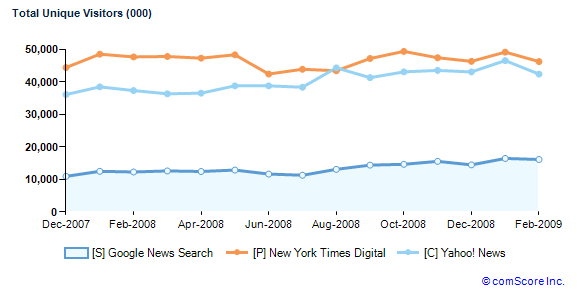
So how powerful is Google when it comes to parceling out traffic to news sites? If you are talking about Google News, the answer is that it is not quite as powerful as you might think. In the U.S., Google News is overshadowed by both Yahoo News and even the sites controlled by the New York Times (which includes NYTimes.com, Boston.com, HeraldTribune.com, and several other newspaper sites). According to comScore, Google News attracted 16.2 million unique visitors in the U.S. in February, compared to 42.3 million for Yahoo News and 46.2 million for the sites operated by New York Times Digital.
So Google News is not the middleman here. Let’s just put that notion to rest. Yahoo News is three times as large, and Yahoo sends even more traffic to newspaper sites from other parts of Yahoo through its onlinenewspaper consortium.
The bigger question is whether Google as a search engine is controlling access to news sites. That really seems to be Carr’s main concern, although it is not clear because he uses a Google News search as his main example. Nevertheless, Google’s main search engine is certainly a major source of traffic to information sites of all stripes. At TechCrunch, for instance, it is the single largest source of traffic, accounting for about a third of the total. I have no idea whether this is representative of other news sites, but it wouldn’t surprise me. Google search is a very important middleman indeed.
Does that make Google like Wal-Mart, as Carr suggests, a middleman of such might that it squeezes everybody else’s margins? Does that give it “monopoly control over content distribution,” as Scott Karp tries to argue? Not exactly. Information economics work slightly differently than retail economics. Let me stick with the TechCrunch example. One third is a lot, but it is not a monopoly. Google sends us all of that traffic because many of our posts rank highly for the topics they cover. We don’t pay them for that traffic. We are not buying keywords.
Yes, Google makes money from other ads shown besides any searches where TechCrunch posts shows up as results. But the money Google makes from those ads does not detract from our revenues. Quite the opposite. Those searches send a considerable amount of traffic to our site, where we have our own ads. The more people who see those ads, the more we can charge for them. It’s all good.
Google does not control the news, it exposes it.
The retail/distributor analogy is all wrong. Information is not the same as a flat-screen TV or a blender. It does not become less valuable the more available it is because all news is not the same. Information dissemination is not a zero-sum game. Carr and Karp would have you believe otherwise. Karp writes:
The more content there is on the web, the less money every content creator makes, and the more money Google makes by taking a piece of that transaction.
Again, that is not how it works. Google doesn’t force suppliers of information to charge less for it as Wal-Mart does with suppliers of packaged goods. The money Google makes from its search ads is not necessarily money that would have otherwise gone to a “news” or content site. If Google didn’t exist, those ad dollars might have gone to an e-commerce site or a travel site or a real estate site or any number of other places. News sites have no claim to those search advertising dollars. It is incumbent upon each of us to attract an audience by having something original or interesting to say. When news sites do that, other sites link to them, and then they rank more highly in Google search results, which sends new readers their way.
And then once those readers do find a news source they trust, you know what? Some of them actually keep coming back on their own volition without Google telling them what to do. That is called direct traffic. Or they come through other sites. Google isn’t the only one who benefits from all those links. If you want to be known as an authoritative source of news, it is no longer good enough to simply proclaim yourself to be one.


 "
" Facebook
 LinkedIn
 about adEcon
 MarSP
MarSP rich media
 top
top blog
blog newspaper
 social network