from TechCrunch by Erick Schonfeld

It’s not a good time to be a print magazine right now. Even a crowdsourced magazine with a stripped-down staff that relies on the contributions of it more talented readers. JPG Magazine and its parent company 8020 Media is shutting down after running out of money and not being able to find any new investors. The seed investment had come from Cnet founder Halsey Minor, who apparently also did not want to put in any more.
JPG was an attempt to create a photography magazine that relied on its readers for its content and included them in the editing process. Nearly 200,000 photographers have submitted photographs for consideration to JPG, many of them via Flickr. The site itself was able to attract about 300,000 unique U.S. viewers a month (Quantcast), but its business model relied on selling print ads. And that’s a business you don’t want to be in right now, especially if you are a startup with an artsy photo mag that was never very appealing to advertisers.
But it was a worthy experiment nonetheless. 8020 Media was founded upon the belief that a print magazine publisher could be viable if it stripped out most of the costs and created a community of readers to help in its production. Perhaps the flaw was in sticking to a print magazine as its final product. In reality, the print magazine was nothing but an artifact of the Website and the community that created it. The value of JPG was in the online portion—the process by which the best photographs were commissioned, curated, and selected with the help of other reader-photographers. It is a model that I believe we will see more of in the future because talent is everywhere. We just need a better way of finding and highlighting the very best of it.
You can download back issues in PDF form before the site goes down on Monday.
 The online readership numbers of 8020 Media's two user-generated (professionally edited) magazines were off to a good start at 5 million pageviews a month. But the company's real business was print, and those numbers apparently weren't goos enough. Investor Halsey Minor has pulled the plug.
The NYT's Brad Stone:
8020 Media was backed by Halsey Minor, the founder of CNet Networks, and located in the San Francisco office of his investing firm, Minor Ventures. It had an unusual, low-cost editorial structure that many media and technology pundits pointed to as a model for the future. JPG Magazine had a small staff but solicited contributions from amateur photographers and asked its community of readers and contributors to vote for the best pictures, which then made it into a bimonthly print magazine. The company's similar travel magazine, Everywhere, ceased publication in August.
JPG had a circulation of around 50,000 and had recently secured some prominent space on newsstands around the country.
But ultimately the money ran out, and Mr. Minor declined to invest more, according to a person with knowledge of the situation. 8020 was attempting to either raise more money from other investors or to sell itself to big media names, including Meredith Corp. and Conde Nast, but with no success....
The 18 employees who worked for 8020 were given the holiday week off. On Tuesday, they received individual telephone calls and e-mail messages telling them that the company had exhausted its options and was shutting down.
8020 CEO Mitchell Fox:
In the face of these extraordinary economic times, in a devastated advertising climate, we can no longer continue to operate the business due to lack of funds, and hence we have to close 8020 Media effective immediately.
There is no doubt that our company has done what no others have yet to do that is, prove that the web and print can work effectively together, one supporting the other.
We've also proven that community generated media CAN be a powerful thing and it can create spectacular media.
The riddle of having a sound web platform support that drives interactivity with a print product has been solved, however, none of us could have predicted the global economic collapse we've witnessed in the past few months. So our timing to grow the business and bring it to profitability through even the smallest amount of additional funding could not have been worse.
So, while we sit here at the precipice of profitability, the negative marketplace forces are too strong to overcome, and we must take this regrettable action.
It remains undeniable that the publishing industry MUST find a new model, and mass collaboration and participation in the media property is certainly now proven it can be the foundation of this new model (NOTE: This is NOT citizen journalism).
We've cracked the code on marshaling a community around a media property online and in print .and helping them become active , loyal, and engaged participants in both.
We do owe a debt of thanks to Minor Ventures for believing in us, and funding us to this point and to have even given us a chance to make this business successful, and for that confidence we'll always be grateful.
8020's description of itself:
About 8020 Media
We are a revolutionary new hybrid media company, bringing together the best of the web and print. We harness the diversity and depth of online communities to create printed magazines that are uniquely relevant and insightful with an incredibly engaged audience. Started in June of 2006, and publishers of the award winning JPG Magazine and Everywhere Magazine, 8020 Media is backed byHalsey Minor, founder of CNET.
The Process
8020 Media empowers its communities to participate in all aspects of the magazine's content creation, thereby dramatically increasing reach, lowering costs, and engaging a knowledgeable, global community. By opening the field, we're blurring the lines between professional and amateur, inspiring photographers and writers of all types to engage in the process. What was once 'the audience' has been invited to participate in and lend its expertise to the editorial process by contributing content and critique online.
The Best of the Web and Print
The web is superior for organically growing real communities, connecting people to one another and housing and culling data. Magazines better provide serendipity and have a tactile, experiential element.
8020 Media takes the best of both worlds by empowering online communities in the process of creating beautiful, printed magazines. The editorial staff, freed by this pioneering reformulation of traditional roles, then function as curators; gleaning the best and most unique content from the vast pool of materials submitted by their contributors. The editorial role shifts from its traditional heavy-handed function, allowing the editors to peer into the collective and capture the perspective of their readers rather than over-stylizing the content. The results of this bottom-up approach are relevant, refreshing publications integrating editor, reader, advertiser and community.
Ed:
- Labor burnrate of 18 or $300k/month
- Revenues from 50k subscriptions, advertising did not cover print costs
- Online revenues were small from skyscrapers and sponsor spots - can't cover direct selling costs
- Community of photographers; failed to draw beyond immediate community
- Good execution, poor productivity as measured by revenues per labor cost


 Moving a Blog from WordPress.com to WordPress.org is something I’ve had a lot of questions about - today
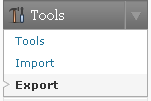 To start things off, login to your WordPress.com account and browse to your administration panel. From the menu on the left, click on TOOLS - EXPORT. At this point, you have the option to confine the export to a particular author or all authors. Using the export tool will compile yourposts, pages, comments, custom fields, categories, and tags. This information is placed into a WXR file or, WordPress eXtended RSS file. Essentially, this file is just a normal XML RSS based file with a couple of custom fields added to it which makes it specific to WordPress. Once you’re finished, click on theDownload Export File button and save it to your desktop.


 "
 Facebook
 LinkedIn
 about adEcon
 MarSP
 rich media
 top
 blog
 newspaper
 social network
