[ About Us | Popular | Marcom | AdNet | IChannel | Glossary ]
Showing posts with label social media. Show all posts

Jun 11, 2009

Facebook Trumps MySpace, Twitter Among NBA, Nascar Fans

Ed: My guess is that the absolute number of participants was pathetic - raising questions about the statistical significance of this article/conclusion. 

Turner: But Those on MySpace Are the Most Vocal When Using 'Social TV'

NEW YORK (AdAge.com) -- Pop quiz: What is the social network to which Nascar fans flock?

If you guessed Facebook, you would be right -- at least according to data from Turner Networks, which recently made Nascar and NBA viewing social by letting users sign in to the various online networks to chat about the basketball games and races. But MySpace users are the most vociferous and accounted for the largest percentage of chatter about live sporting events.

Users watching the NBA's Eastern Conference Finals could log on to Turner's companion websites and chat with fellow viewers.

MySpace: Most vocal
Turner launched the social-viewing option using a service called Socialize from social-media technology provider Gigya. Users watching the NBA's Eastern Conference Finals or Nascar's Pocono 500 live could log on to Turner's companion websites using Facebook, MySpace or Twitter (or a combination of those) to chat with fellow viewers. The cable network found Facebook represented, on average, 48% of Socialize log-ins during the NBA games, while MySpace came in a very close second at 40%. Twitter users composed 12%. But from a message-volume standpoint, MySpace users were the most vocal, accounting for 53% of all the messages sent.

In last weekend's Nascar race, the Pocono 500, the difference among log-ins was more pronounced: Facebook accounted for 54% of users; MySpace was half that at 27% and Twitter trailed with 10%. Again, MySpace users talked the most, accounting for 44% of message volume despite only 27% of log-ins.

"I think everyone was surprised at how competitive MySpace was," said Dave Yovanno, CEO of Gigya. "It's not an all-Facebook social web -- users have choice. MySpace is not out and, in fact, was very competitive in terms of total connections and messages." Mr. Yovanno suggests there will be consolidation on the social web, "but we expect there to always be a few dominant platforms."

Turner's agnostic view
The practice of letting people log into TV network's website through their social-network IDs was made popular when CNN.com encouraged those viewing President Barack Obama's inauguration online to sign in using their Facebook accounts so they could chat live; shortly after that Turner used the same service, called Facebook Connect, to let users chat while watching the NBA All-Star Game. But over the past couple weeks, Turner became the first TV network to adopt an agnostic view, letting users sign into MySpace, Facebook and Twitter.

"We were going to allow the Facebook guy to chat with the MySpace guy to chat with the Twitter guy," said Matthew Hong, VP-general manager of sports digital at Turner Sports.

In both cases, on-air mentions drove people to the Turner sites where Socialize lived. During the Nascar race, the on-TV commentators also answered questions from the social-networked audience.

Turner isn't releasing total numbers of users who logged in using their social-network IDs, but Mr. Hong said it was pleased by the "better user experience and higher engagement," as indicated by the time people are hanging out in Turner's interactive environments. "The early return is it gives people an opportunity to participate in our content," he said.

That Twitter, which just launched its own Facebook Connect service, called Log in With Twitter, trailed the other two networks shouldn't come as a surprise to anyone following web traffic trends. Despite the hype and rapid recent growth, Twitter has far fewer users than Facebook or MySpace. According to ComScore's figures for April, Twitter notched 17 million unique visitors to Facebook's 67.5 million and MySpace's 71 million.

How the numbers break down

Nascar on TNT (Pocono 500) Users:
MySpace: 27%
Facebook: 54%
Twitter: 19%

Nascar on TNT (Pocono 500) Messages:
MySpace: 44%
Facebook: 37%
Twitter: 18%

NBA Eastern Conference Finals Users (average of all games):
MySpace: 40%
Facebook: 48%
Twitter: 12%

NBA Eastern Conference Finals Messages (average of all games):
MySpace: 53%
Facebook: 35%
Twitter: 12%

May 31, 2009

Poll: Business People Say Twitter More Important Than LinkedIn

Ed:
  • Enterprises favor Twitter for brand marketing.
  • Consultants favor LinkedIn for B2B marketing.
  • Small businesses vary depending on their focus.
  • Digg is for geeks.

A month-long poll conducted on business social network LinkedIn has uncovered some fascinating numbers concerning social media platforms and brand presence. The biggest surprise was that Twitter was deemed more important to brands than LinkedIn, and the poll was performed on LinkedIn. With more than 3,600 respondents so far, each well understood in terms of job titles, company size, age and gender - this is a high-quality data set worth paying attention to. The question asked was simply: "What is the most important new platform for brands to master?" Options were Twitter, Facebook, the iPhone, Digg and LinkedIn.

Some of the conclusions were a real surprise. Others confirmed our suspicions. Read on for charts, bullet points and a few thoughts.

Below are charts breaking out the poll responses from various groups and some text we've written to interpret those charts. It's important to remember the question wasn't "what do you prefer" but rather "what is most important for brands to master." Those are related but different questions.

Just for context, we'll start with a traffic graph.

Key takeaways from the poll:

Overall


LIBrand1.jpg

  • Twitter is #1, leading Facebook by a respectable margin
  • The iPhone is considered less important than LinkedIn
  • Almost no-one thinks Digg is the most important
  • There is no consensus; every platform named (except for Digg) has a group of backers that believes it is most important.


About the respondents


  • 3,615 respondents is a very good number
  • Only 4% were business owners, 26% managers, 56% non-managers
  • 75% were from small businesses
  • 26% were marketers, the largest percentage among job functions
  • Twice as many men responded as women
  • 83% of respondents were between the ages of 25 and 54, only 17% younger or older

Most appreciative of Twitter: Business owners, C-Level or VPs. People at large- or medium-sized companies. People doing business development, marketing or creative work.

Least appreciative of Twitter: Non-managers. People at very large or small businesses. Consultants, Salespeople and Engineers.

Most appreciative of LinkedIn: C-level and non-managers. At small- or medium-sized businesses. Doing consulting or sales.

Least appreciative of LinkedIn: Owners and managers. At large or enterprise companies. In creative or marketing departments.


By Job Title


LIBrand2.jpg

  • Business owners are most likely to put Twitter at the top, non-management people are least likely
  • Non-managers are most likely to favor LinkedIn, owners are least likely
  • Non-C-level or VP managers are most likely to favor Facebook, owners are least likely
  • About 1 out of 5 people in all positions favor the iPhone


By Company Size

LIBrand3.jpg

  • Large businesses are most likely to favor Twitter
  • Medium and small businesses are twice as likely to favor LinkedIn
  • Small businesses are twice as likely to favor Digg
  • Medium-sized businesses are least likely to favor the iPhone


By Job Function

LIBrand4 .jpg

  • Marketing, business development and creatives are most likely to favor Twitter
  • Consultants and sales are least likely to favor Twitter
  • Creatives and marketing are least likely to favor LinkedIn
  • Consultants and sales are most likely to favor LinkedIn
  • Consultants are most likely to favor iPhone, marketing least likely
  • Engineers are far more likely to favor Digg than anyone
  • Marketing is most into Facebook, business development the least (prefers Twitter)


By Gender

LIBrand5.jpg

  • Women are much more likely to prefer Twitter
  • Men are more likely to favor LinkedIn, iPhone


By Age

LIBrand6.jpg

  • 55+ far more likely 75% than anyone to favor LinkedIn
  • 25-54 more likely to favor the iPhone than younger or older people

So what do you think? Surprises? Confirmed beliefs? This looks like good quality data to us so we suspect we'll be thinking about it for a while. Two things are for sure - there's no topping LinkedIn for professional background information, and there's no chance we'd be able to trust a poll like this if it was performed on Twitter!

Thanks to Tom Humbarger for Twittering about this poll; that's how we found it.

Apr 16, 2009

Terminology Matters: Why 'Social Media' Sucks

Here's a New Lexicon to Help You Think Clearly

Josh Bernoff
Josh Bernoff

As I speak with companies that want to engage with their customers in the online social world, I continually find people confused as soon as they begin talking about "social media." The reason is the baggage that comes along with the word "media."

Media is something that media companies control, and media is overwhelmingly one-way. The online social world is about as two-way, multi-way, any-way as it can be. Nobody controls it, not even Facebook, which found it can't even change its own terms of service.

Media is something people spend time with. So are online social interactions. That's a pretty tenuous reason to call it media. And while, as in media, you can advertise in social network sites, that is the least interesting use for them.

Here are some words you can use to think more clearly.

If you want to refer to the whole world of people connecting and drawing strength from each other online, you can call it the "social web" or the "social internet" (or you can call it the "groundswell," if you wish). It includes huge sites such as MySpace, communities, YouTube, the blogosphere and so on. (You could call the whole thing "Web 2.0," but people often use that term to refer to a set of technologies -- not the best way for advertisers to focus -- and it doesn't get directly at the people-to-people aspects.)

If you want to build an environment where consumers or other customers connect with you and each other, call it a "social application." It could be a community, a user-generated-content site, or even adding ratings and reviews to your site. By calling these applications, you remind yourself that 1) it's going to take some effort to build it right, and 2) people will interact with it. And you may even remind yourself that 3) it could last a long time, rather than coming and going quickly as advertising campaigns and media do.

If you're going to participate in a big social site (Facebook, MySpace, Twitter, YouTube), call it a "social-network site" (or just a "social network," for short). And you're often better off with a channel or a profile or an identity than an ad in such an environment.

But no matter what you do, the sooner you stop thinking of the social web as media, the better off you are.

~ ~ ~
Josh Bernoff is the co-author of "Groundswell: Winning in a World Transformed by Social Technologies," a comprehensive analysis of corporate strategy for dealing with social technologies like blogs, social networks and wikis, and is a VP-principal analyst at Forrester Research. He blogs at blogs.forrester.com/groundswell.

Mar 16, 2009

CLIP: Social Media Marketing Up During Recession

Web Strategy by Jeremiah by 

recession

I’m sitting across the street from the SXSW convention center, yesterday the organizer Hugh Forrest told me that attendees to the Interactive portion (a great deal with a focus on social) was up aprox 20% (just an approximation). I’ve seen many social media strategists (see list) here at the conference that are here to network with the influencers, get educated at the sessions, and to soak in what community really means.

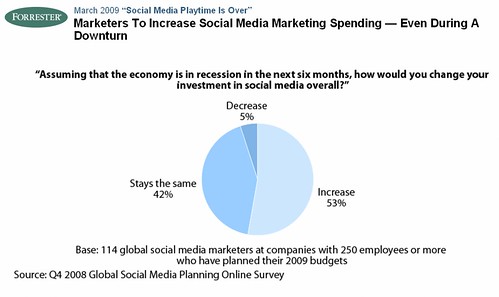
During a recession, marketers are often forced to reduce budgets, in fact, it’s often one of the first buckets to get trimmed. In our latest research, we found that 53% of marketers are determined to increase their social media budget during a recession. Why? The reasons are obvious, it’s inexpensive, the opportunity to benefit from cost-effective word-of-mouth and of course, it’s where many marketers see the future.

Now this doesn’t mean that budgets are expanding immensely, since this is a ‘new’ media, these are small budgets. How small? Three-quarters of marketers have $100,000 of less budgeted for social media marketing.

Even though the budgets are small and growing, we recommend to our clients, in order to be successful, not to approach social media marketing as experimental, but to put the right roles, process, and measurement capabilities in place to be effective. Remember, the most expensive cost isn’t the tools, the most expensive part is the soft costs: strategy, education, process, roles, measurement).

Key Takeaway? Social media budgets are small, but are growing during a recession, yet brands shouldn’t approach this as an experiment, and should have a proper strategy complete with objectives, roles, processes, and measurement.

Mar 9, 2009

CLIP Social Networking Now More Popular Than Email, Report Finds


Ed:
  • Good data, wrong conclusions below.
  • Facebook delivers as much junk as email. The problem is that email is broken, with good mail going into spam, and bad mail slipping through.
  • Social networks multiply as younger groups have pulled older groups into the fold. They are closer than friends - families.
  • Facebook eliminates the need to maintain email addresses. Just connect.
  • Sharing on walls and feeds is something for everyone to learn more about. Same with open Twitter feeds. Pundits who claim to understand - do they really?
Written by Marshall Kirkpatrick / March 9, 2009 9:51 AM 

Nielsen Online, an analytics firm that tracks time spent online at various websites, has issued a report finding that throughout 2008 social networking sites and blogs saw more time spent by users than personal email. While not shocking, the finding does mark an important point in the history of the web.

Youth watchers have long argued that for young people, email is how you communicate with elders in formal situations, while social networks and SMS are the preferred method of communication among peers. Nielsen found, however, that Facebook in particular saw greater growth among older people than it did among the young.

This shift has primarily been driven by Facebook whose greatest growth has come from people aged 35-49 years of age (+24.1 million). From December 2007 through December 2008, Facebook added almost twice as many 50-64 year old visitors (+13.6 million) than it has added under 18 year old visitors (+7.3 million)
socnetgraph.png

Our take away from these findings? People prefer the clean, controlled, multi-media and publicly social experience of social networking communication over the relatively open, individualistic and spammy medium of email. The fact that there is effectively no data portability allowing communication archives to be ported from one social network to another as there is with email doesn't appear to be bothering people in the short term. We wonder if it will in the long term.

For a more in depth look at this phenomenon, check out danah boyd's latest analysis titled "Social Media is Here to Stay - Now What?."

Feb 20, 2009

How to Reach Baby Boomers with Social Media

Ed: Please check out:

new report from Forrester Research revealed some surprising information: apparently Baby Boomers aren't exactly the technology Luddites that people think they are. In fact, more than 60 percent of those in this generational group actively consume socially created content like blogs, videos, podcasts, and forums. What's more, the percentage of those participating is on the rise.

In 2007, the percentage of Boomers consuming social media was 46% for Younger Boomers (ages 43 to 52) and 39% for Older Boomers (ages 53 to 63). By 2008, those number increased to 67% and 62%, respectively.

The number of Boomers reacting to content posted online, as opposed to just passively consuming it, is also trending upwards. For example, the proportion of Older Boomers reacting to content doubled from 15% in 2007 to 34% in 2008. According to Forrester, this is now a percentage that's high enough to target this group with a social application.

Joining social networks is also becoming a widely popular among the Younger Boomers. Today, almost one in four Younger Boomers are active in social networks, up from 15% in 2007.

boomer_data.png

The one thing that Boomers are less likely to do in the online world is actually create content - outside of updating their online profiles and leaving blog comments, that is. Boomers are still not involved heavily in writing blog articles or creating videos and posting them online. In 2008, 16% Younger Boomers were involved in content creation (up from 12% in 2007) and 15% of Older Boomers did so (up from 8%). Although both groups saw an increase, it's still the least popular activity.

What This Means

For companies wanting to reach out to the Baby Boomers online, this data shows that spending at least a portion of your budget on social applications for the group isn't entirely a waste of time and money. The group isn't as active online as younger generations are, but their participation levels are now moderate and increasing.

The best bets for getting Boomers interested in your content is to create blogs or videos that relate to the life or work-style of Boomers, Forrester suggests. And if you're looking for feedback and contributions from the Boomers themselves - like comments or criticisms - make that process dead simple. Don't introduce overly complex sign up forms or processes. Instead, encourage low-effort contributions such as star ratings.

Marketers can also look into reaching Boomers through social networks now - specifically those favored by this generation like Classmates OnlineEonsBOOMj.comTeeBeeDee, and even the AARP's online community. There is some participation in these social spaces now, but even more growth is expected over the next 12-month period.

Feb 18, 2009

CLIP Survey Of Insular Social Media Elite Says: Twitter Is Better Than Facebook For Businesses


If you were to ask “over 200 social media leaders” which social media site they would pay for if they had to, as Abrams Research recently did, Facebook would come out on top, with 32.2 percent saying they would pay for it. (Yeah, right). LinkedIn was second, Twitter was third, and MySpace and Digg tied for last place (with only 1.5 percent of respondents saying they’d pay for those services).

But if you ask, which one would they recommend for businesses to pay for (if they had to), Twitter beats Facebook by more than two to one (39.6 percent vs. 15.3 percent). LinkedIn again comes in second. Why did Twitter come out on top. It is seen as an efficient way for companies to get their marketing messages out there. One typical response:


It’s the quickest way I’ve seen to spread information virally to a wide scope of people attached in a lot of random ways.

The survey was taken at Social Media Week 2009 and included “founders, bloggers, journalists, entrepreneurs and members of the Twitterati.” Basically it is the opinion of the insular social media elite. So what they say may just be wishful thinking, but the results are good fodder for discussion nonetheless.

Abrams also asked which social media service is most likely to die first. ImInLikeWithYou is given the worst odds of survival, followed by Bebo, and FriendFeed. Below are the questions and the results. Pipe in with your own answers in comments.

1. Which social media service would you be most likely to pay for?
Facebook 32.2%
Linkedin 29.7%
Twitter 21.8%
YouTube 13.4%
MySpace 1.5%
Digg 1.5%

2. What social media service would you advise a business pay for?
Twitter 39.6%
Linkedin 21.3%
YouTube 18.8%
Facebook 15.3%
Digg 3.0%
MySpace 2.0%

3. Which social media service will be the first to die?
ImInLikeWithYou.com 41.1%
Bebo 12.4%
FriendFeed 8.9%
Meetup.com 8.4%
Flixster 6.9%
Digg 5.0%
Last.fm 3.0%
Other 14.4%

4. Which corporation has done the best job of using social media? (Respondents were asked to choose
one; these were the most popular choices, ranked accordingly)
1. Zappos (online shopping site)
2. Obama (campaign and presidency)
3. CNN
4. Comcast (“Comcast Cares”)
5. Jetblue
6. Dell
7. Burger King
8. NPR
9. New York Times
10. Ford

Feb 9, 2009

Watching The Grammys: No Live Streaming But Lots Of Twittering, Gossip And Promos

imageWatching the 51st Annual Grammy Awards and anyone who's watching it too will understand why I'm not paying full attention. Disappointing because with all our focus on music lately, I was looking forward to this one ...

Not online: The signature event is meant to bring people to CBS (NYSE: CBS) so the show isn't being streamed live. The award for the most nonsensical explanation goes to the official Twitter feed from TheGRAMMYS: "there is no official way to stream the GRAMMY Awards live online. We do not have a published schedule of performances." (The pre-telecast ceremony was streamed live and is available on demand for the next month.) Seriously. In addition to Twitter, The Recording Academy has an official Facebook presence, an iPhone trivia app, blogs, video but so far no legit way to see the MusiCares Neil Diamond tribute from Friday night. CBS.com features a music video challenge sponsored by Lincoln; users can vote for the Project Rising Stars winner. You can also vote for the My Grammy Moment finalists. No official way to vote for least favorite performance by someone people usually pay to listen to.

Speaking of Twitter: Real-time interaction definitely adds a different dimension to watching something live. Wonderwall's Alex Blagg says it makes award shows relevant again. What it really does is transform the experience into a kind of warped communal event—warped, because so much of it is anonymous and people feel like they can say absolutely anything no matter how personal, but still community because it's shared. Igot to vent about the golden banana entry by Katy Perry (seriously awful) and was able to reassure myself that the muddy sound was not because my ears rebelled against the latest flight. I did try to restrain myself, hence no snarky comment on gum-chewing Adele. (Update: Time delays make this totally surreal; it's like watching the wave go around a stadium in slo-mo.)

CBS Radio: Can't remember last year's efforts but this year CBS is making a serious push to CBS Radio and CBSRadio.com. Users who follow the visual cue from the TV to CBSRadio.com can click on a format (rock, pop, R&B, rap, country, adult pop) and be directed to a CBS station where they can listen live now. The CBS unit now programs AOL Radio—leading to a promo for the "AOL Radio powered by CBS Radio" iPhone app—and starting Feb. 16, will power Yahoo LaunchCast, too. The latter will have 150-plus stations but user-customized "my stations" will disappear.

Gossip: In addition to myriad red carpet pix, the real-life police drama that kept Chris Brown and Rihanna away from the show tonight plus Usher's last-minute departure for family reasons are giving gossip sites a workout likely to continue well into tomorrow. Gabe Rivera's WeSmirchis the best way to keep track of the not-so-good, the pretty bad and the very ugly.


Feb 3, 2009

How Obama's 'Permanent Dialogue' Affects Marketers

His Direct, Always-on Communication Will Change What Consumers Expect From Us

Pete Snyder
Pete Snyder

Change has come to Washington and is coming rapidly to all of America. And I'm not just talking about the fact that there is a new president with a new agenda that likely will be in stark contrast with the past administration.

I'm talking about the way the President Obama and his campaign communicates with constituents. We all know he used technology, the internet and social media to engage and motivate voters and, ultimately, win the White House. Assuming Obama does what he said he will do when it comes to social media, his administration's behavior will change the expectations of the consumer and the brand-consumer relationship.

Remember how the Clinton campaign changed the way advertising, marketing and communications operated with the notion of "The Permanent Campaign" -- always raising money, always running ads. (And suddenly no company in crisis was complete without a "war room.") More significantly, the Obama Administration brings with it the notion of "The Permanent Dialogue."

Consider: In a Pew post-election study, 51% of respondents said they expect the President and his administration to communicate with them "directly." Not through broadcast speeches to the nation. Not through the media. Not through the briefings by the White House Press Secretary. If the majority of the coalition that elected Barack Obama expects him to directly speak and consult with them, what do you think they will expect of their mobile phone service, automaker or cable/broadband provider? What will this mean for what employees and shareholders expect from CEOs? It will be awfully hard to hide behind spokespeople, exec VPs and assistants blocking calls if the president of the United States has more contact with your employees than you do.

Brands and marketers need to come to terms with the fact that we now have a president (and an administration) who understands the internet and is an active in -- dare I say a "power user" of -- technology. After all, this is the first president in history to refuse to give up his Blackberry. More importantly, we need to understand how this will impact not only the behavior of American consumers, but also how the new Communicator-in-Chief will change what they expect from all of us.

ABOUT THE AUTHOR
Pete Snyder is the founder and CEO of New Media Strategies. He also is a former GOP pollster and media consultant. Full-disclosure: He voted for McCain.

1. The battleground for both consumers and ideas is online.
What was the first action of the Obama administration? Launching a much more social-media-centric White House website, several minutes before Obama took the oath of office for the first time. Why is this relevant? It sends a clear message that the Obama administration views the internet as the "tip of the spear" -- the first (and, in some cases, primary) battleground as it seeks to push its agenda forward. As the President said: "I didn't use technology and the internet just to win a campaign, we're going to use it to change America."

2. The permanent dialogue has begun.
The president and his team aren't going to keep their database of 15 million supporters behind closed doors. Rather, they will harness these supporters into an army of spokespeople, unleashing them across social-media platforms and millions of blogs, not to mention, town halls, coffee shops and church basements. This dialogue won't be limited to politics and policy (you think its easy keeping 15 million people on topic?). The permanent dialogue will touch every industry and consumer brand. From YouTube (comments enabled, we hope) to live-streaming video via platforms like Qik, from blogs to micro-communication tools like Twitter and text messages, consumers are creating, sharing, interacting with and seeking out content about anything and everything at a staggering pace. If you aren't listening to that dialogue, you better start.

3. Consumer expectations will change.
Just as the public quickly adapted their behavior and expectations of news and the media with the rise of the 24/7 news cycle, a big shift will happen here, too. Consumers adjust and come to expect a permanent dialogue with them and their leader, don't you think they will expect the same from the other institutions (many parents now expect weekly if not daily communications from their child's teacher), corporations and brands that touch their lives? Change is here. And this means they're changing their expectations of YOU.

4. You'll need an active, authentic voice in the conversation.
You can't participate in the permanent dialogue if you don't bother to show up or speak up. When consumers search on Google or go poking around Facebook, they expect to have a fulfilling, self-driven and authentic experience. They disregard most banner ads, are impatient when pre-roll loads before a video and are annoyed when a full screen flash advertisement gets in between them and the article they want to read. This type of interruptive marketing is not how Obama communicates. Obama used conversation-based marketing and opt-in access to build lasting, trust-based relationships. Go where they are. Be real. Create an actual relationship.

Change is here and more change is coming. Not just in politics and policy, but in how consumers behave and what they expect of us. They'll demand to be closer, deeper and more direct than ever before. The question is no longer are you online, but rather, are you listening, directly available and authentically interacting. Embrace, harness and make social media work for you -- or get left behind. It's a lesson from the very top.

Jan 31, 2009

CLIP Driving Change: Selling SharePoint and Social Media Inside the Enterprise

Businesses and established organizations are vastly different environments than the Web 2.0 social networking-centric universe. Where Web 2.0 is all about sharing information and engaging in two-way conversations, the enterprise concerns itself, in part, with individuals who are guarded with information and an organizational structure that disseminates information in top-down fashion. From my experience of evangelizing the benefits of social media at a mid-sized civil engineering company, I have learned many lessons on how the enterprise regards and judges social media.

This is a guest post written by Jason Harris, a technology writer and SharePoint administrator.

The company I work for consists of roughly 950 employees spread across 23 offices up and down the west coast of the United States and some points eastward. How do I drive SharePoint and the concept of social media in a company in which most of my clientele consists of middle-aged civil engineers, most of whom don't see any benefit to making their work more social?

Problem: Individuals are Unaware of the Basics of Social Media

In the enterprise, many employees think blogs are merely websites on which people talk about their cat or their latest meal. Many don't know the differences between and advantages of such tools as message boards, blogs, and wikis. They have heard of these terms in passing, but the demands of their day-to-day jobs have prevented them from recognizing the distinct benefits of each tool.

Solution: It is useless to advocate for social media tools in a vacuum. Unless you're describing a solution to a practical problem, busy workers will not respond to buzzwords like "wiki," "blog," and "community." Your client usually has about a 30-second attention span in which you can sell a social media tool.

An aide in my arsenal has been the excellent videos by Lee Lefever at Common Craft. Lee visually explains social media concepts "In Plain English." Common Craft videos quickly explain complex and sometimes unfamiliar technologies in a few minutes, sans the buzzwords, hype, and sensationalism.

Problem: Cynical Clients Who Don't Want to Share Information

Unfortunately, some potential SharePoint users balk at the technology because they have no desire to share their knowledge for the benefit of the organization. These individuals tend to equate their knowledge with job security; therefore, they feel nervous about sharing out of fear that they wouldn't be needed any more.

Solution: As Guy Kawasaki says, "Look for agnostics, ignore atheists." If you sense your potential client has no interest in sharing information or contributing to an online community (in this case, powered by SharePoint), move on to other parties who would be interested in building a knowledge base and community.

Often, when people thumb their noses at the concept of a SharePoint website housing a body of knowledge, the time comes when they turn to that website or community for a piece of information to complete a task or carry out a project. As a result, they'll see the value of the online community and will be more inclined to contribute their knowledge to it.

Problem: Knowing Where to Start

Information technology managers and business folk have heard stories about the benefits of social media use in the enterprise but are unsure where to start.

Solution: Analyze your particular circumstances. Technology alone won't fix or alleviate a business problem. Merely throwing up a wiki and publicizing it doesn't guarantee its success. Instead, use collaborative technologies such as SharePoint to solve the problem.

For example, some companies have tedious workflows to address routine functions, such as requesting time off and filling out time cards. SharePoint has built-in features that help complete these functions quickly and easily. Take time-off requests, for example: Microsoft has aspecific site template for this very purpose (which is free).

The point here is to take collaborative technology and apply it to processes that are routine and can be easily completed. This low-hanging fruit shows users the benefit of embracing a new way of doing things. At this point, when their minds are spinning at the possibilities, you can suggest other areas in which to apply SharePoint and other collaborative technologies.

Social media, collaboration, and tools such as SharePoint deliver many benefits to work groups and teams of all sizes. There are many challenges to overcome, many of them either mental or political, but the rewards definitely outweigh the hurdles. With care, nurturing, and proper execution, your work group or enterprise will enjoy the numerous benefits social media have to offer.

This guest post was written by Jason Harris, a technology writer and SharePoint administrator. To follow him, read his blog.

Jan 27, 2009

Trinity Mirror joins the social media revolution

Posted by Lauren Drablier on January 27, 2009 at 10:02 AM
Trinity Mirror has joined other media organizations and newspapers in the social media revolution by introducing new interactive tools to its websites in collaboration with social media firm Pluck.  The tools will be incorporated using APIs and widgets, Journalism.co.uk reports.

According to David Black, Trinity Mirror's group director of digital publishing, "Our strategy is all about building a really engaged online audience. We see interactivity as absolutely critical to improving the experience we offer to our users." 
Pluck's features will appear on Mirror.co.ukSunday Mail and Daily RecordLiverpool EchoCoventry Telegraph and Gazette Live websites.  

More additions planned for later this year are individual profiles and the implementation of user comments.

About Pluck

A leader in social media software solutions, Pluck helps transform how publishers, retailers and major brands engage their audiences and customers to discover, create and distribute content online. Providing the technologies for content generation, syndication and social networking, Pluck helps its customers more easily consume and leverage the new open content model that has emerged as the cornerstone of interactivity online.

Support Our Sponsors: